What does decoupled mean? A guide to decoupled vs coupled
Curious what does decoupled mean? This guide explains decoupled architecture with clear examples and contrasts it with coupled and headless systems.


So, what does decoupled mean in plain English? It’s simply the idea of separating two systems so they can function on their own.
Think about it like a high-end stereo system. You have distinct components—an amplifier, speakers, and a turntable—that all work together beautifully. The key is that you can upgrade your speakers without having to buy a whole new amplifier. Each piece stands on its own.
Understanding Decoupled Systems
This principle of separation is a game-changer in technology. Its opposite, a coupled system, is more like an all-in-one boombox. The speakers, CD player, and radio are fused together. If one part breaks, the entire unit is often useless. A decoupled architecture sidesteps this "single point of failure" by breaking things apart.
In the software world, decoupling means the front-end (what users see and interact with) isn't hardwired to the back-end (where the data and logic live). Instead, they communicate through an API (Application Programming Interface). This API acts as a middleman, letting each side evolve and update without disrupting the other. The result is a far more flexible and resilient setup.
Key Architectural Models
To really grasp what makes decoupled architecture special, it helps to see where it fits in the broader landscape. There are really three common ways to build a system.
- Coupled (Monolithic): Here, the front-end and back-end are essentially one big unit. Think of a classic WordPress installation. It's straightforward and works great for simple projects where everything is managed in one place.
- Decoupled: The front-end and back-end are separate but still aware of each other. The back-end might still handle some front-end rendering tasks, but developers have the freedom to manage and scale the two sides independently. It’s a happy medium.
- Headless: This is the most extreme version of decoupling. The back-end (the "body") has no front-end (or "head") at all. It exists purely to manage content and deliver it via an API to any channel—a website, a mobile app, a smartwatch, you name it. If you're curious about this path, you can explore some great open source headless CMS platforms to see them in action.
This infographic does a great job of visualizing the fundamental differences.
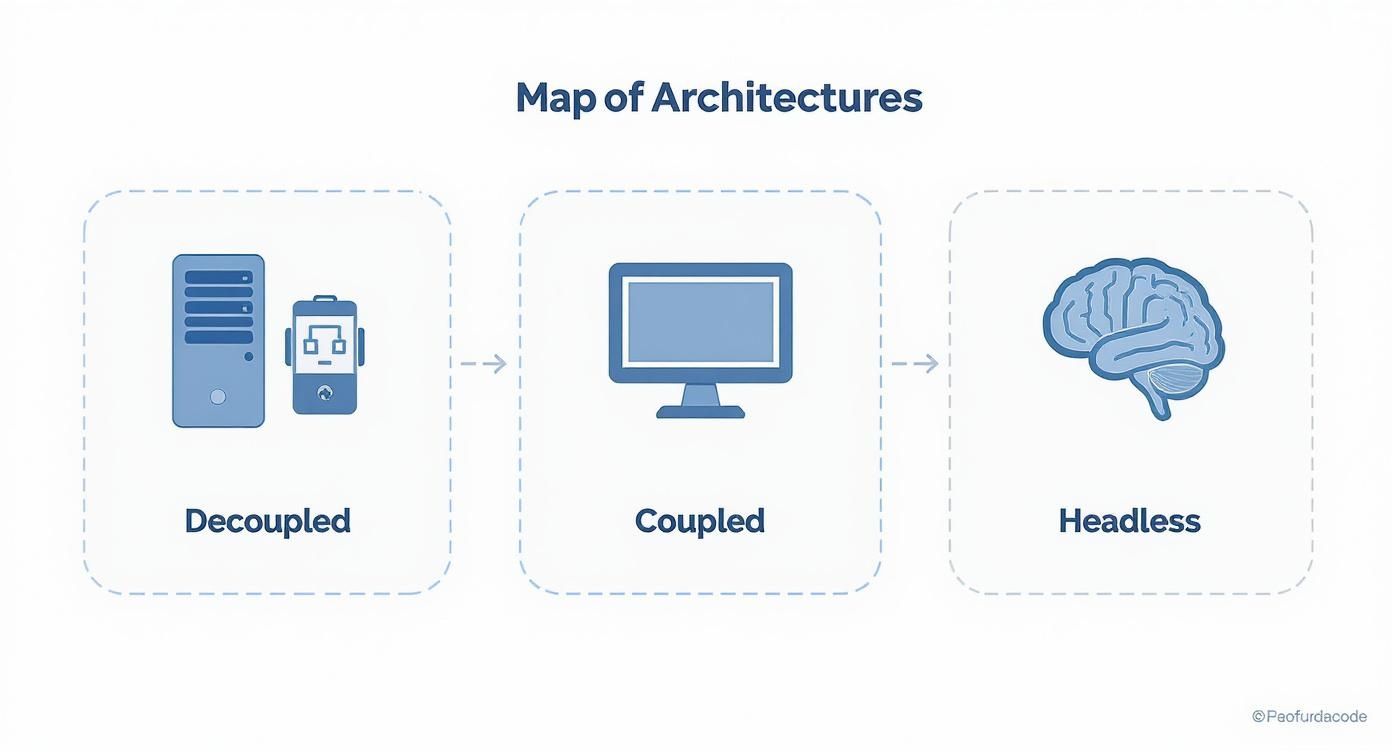
As you can see, coupled architecture is portrayed as a single, restrictive box. Headless is just the "brain" (the content), and decoupled sits right in the middle, offering a strategic balance between separation and connection.
To quickly summarize the core differences, here’s a high-level comparison of the three architectural models.
Comparing Architectural Models
| Architecture Type | Frontend & Backend Relationship | Primary Use Case |
|---|---|---|
| Coupled | Tightly integrated; a single codebase | Simple websites, blogs, small business sites |
| Decoupled | Separate but connected via API | Complex web applications needing flexibility |
| Headless | Completely separate; content-only backend | Multi-channel content delivery (apps, IoT) |
Ultimately, choosing an architecture isn't just a technical decision—it's a strategic one. Decoupling is about building systems that can adapt, scale, and withstand change. By separating the pieces, you give your teams the freedom to innovate without the fear of breaking the entire system.
Coupled vs. Decoupled: A Tale of Two Architectures
To really get what decoupled means, it helps to see it next to its traditional counterpart, the coupled architecture. Think of them as two completely different ways of building a website or digital platform, each with its own logic and best-use cases.
A coupled system, which you'll often hear called a monolithic architecture, is basically an all-in-one box. The backend, where you create and manage all your content, is fused together with the frontend, which is the public-facing website your users see. They’re part of the same codebase.
For a long time, this was just how websites were built. A classic WordPress site is the perfect example. Everything, from the admin dashboard where you write a blog post to the theme that displays it to visitors, is part of one, big interconnected system. It's a simple and direct approach, which is why it's great for projects that need to get up and running quickly without a lot of complexity.
The Decoupled Difference
Now, a decoupled architecture deliberately severs that connection. It makes a clean break between the content management environment (the backend) and the presentation layer (the frontend). They aren't a single unit anymore, but they aren't totally disconnected either. An API acts as a messenger, allowing content to flow from where it's stored to wherever it needs to be displayed.
This separation is a game-changer. It creates a clear divide and unlocks possibilities that are difficult, if not impossible, with a monolithic setup. Developers are no longer handcuffed to the backend's technology stack. They're free to build incredibly fast, modern frontends using their preferred tools, like React, Vue, or Svelte.
By separating the data storage from the business logic applied to that data, each layer can evolve independently. This gives you far more flexibility to adapt your workflows and reporting over time without one change breaking the other.
This isn't just a technical footnote; it’s a strategic move. It allows teams to build digital experiences that are more robust, scalable, and precisely designed for specific audiences. For a closer look at how various platforms are built, our CMS systems comparison offers some great perspective.
A Real-World Scenario
Let's think about a modern retail company. They don’t just have a website. They have a mobile app, digital displays in their physical stores, and maybe even a voice assistant skill for checking inventory.
If they were using a coupled system, they might need a separate CMS for each of those channels. That means duplicating content, which is inefficient and a recipe for inconsistencies.
With a decoupled architecture, they can use one central backend to manage all their product information—descriptions, images, prices, you name it. This "content hub" then uses its API to send that information to any frontend that asks for it:
- The website pulls product details for the e-commerce store.
- The mobile app fetches the same data to show on its product pages.
- The in-store displays request the latest promotional content.
That right there is the power of decoupling. It elevates the CMS from a simple website tool to a true content engine that keeps everything consistent and efficient, no matter where your customers are.
Decoupling Beyond Software Development
The idea of separating systems to make them stronger isn't just for software developers. It's a powerful strategy that pops up in a surprising number of places. When you start to see what decoupled means in other fields, the core idea clicks: you separate interconnected parts to make the whole system more resilient and efficient. It's less about code and more about a smarter way to solve problems in a complex world.
A perfect real-world example is modern supply chain management. Think about an old-school factory where making a product, packaging it, and shipping it are all locked together in one rigid sequence. If a single shipment of raw materials is late, the entire assembly line grinds to a halt. It's a classic bottleneck.
Decoupling that process means creating strategic buffers. A food supplement brand, for example, can keep its packaging line running with existing inventory even if a new batch of bottles gets delayed. By separating these critical operations, a business can keep things moving during a disruption and bounce back faster. Experts at The Jay Group dive deeper into how this builds a more resilient supply chain.
Expanding the Concept to Geopolitics
This same principle even scales up to global economics and politics. You’ve probably heard the term “economic decoupling” floating around in news about the U.S. and China. This is a deliberate strategy to reduce how much the two economic giants depend on each other, especially in sensitive areas like semiconductors and AI.
By intentionally separating their tech supply chains, nations aim to reduce vulnerabilities and protect national security interests. It’s a geopolitical application of the same logic used in software: minimizing the risk that a problem in one system will cause a catastrophic failure in another.
This thinking—separating things for greater resilience—is also fundamental to modern digital infrastructure. Many organizations are applying similar principles with cloud content management systems to build more flexible and adaptable operations.
Decentralization as an Ultimate Goal
Decoupling finds its ultimate expression in decentralization, a model where there’s no central point of control at all. If you look into decentralized app development, you'll see how entire systems can function without a single authority. This takes the idea far beyond just separating software components and shows how a lack of dependencies can create incredibly robust, self-sustaining networks.
Whether it’s on a factory floor or in the arena of international relations, the goal is always the same. Decoupling creates systems that are flexible, resilient, and better prepared for whatever comes next. It’s proof that sometimes, the best way to keep things running together is to first break them apart.
Why a Decoupled Approach Makes Strategic Sense
It’s one thing to understand the technical definition of “decoupled,” but the real question is why businesses are increasingly making this shift. Moving away from a traditional, all-in-one system isn't just a whim for developers; it's a calculated decision that unlocks some serious advantages in how a business operates online. When you separate your content from its presentation, you’re paving the way for major gains in performance, security, and overall agility.
The most tangible benefit you'll see right away is a massive jump in performance. In a coupled system, the frontend is often held back by the weight of the backend technology. Decoupling frees the frontend, letting developers use nimble, modern frameworks like React or Vue.js. These tools are built for speed, leading to faster page loads and a much smoother user experience—factors that directly influence everything from search rankings to sales.
Gaining True Freedom and Flexibility
Beyond the speed boost, decoupling gives your development teams an incredible amount of freedom. Frontend developers are no longer shackled by the constraints of a backend CMS. They can innovate and build unique, engaging user interfaces without needing to wait on the backend team for every little change. This autonomy doesn't just speed up projects; it breathes life into the creative process.
This separation also naturally creates a more secure digital footprint.
By isolating the content management system from the public-facing presentation layer, you significantly reduce the attack surface. The backend, which holds your valuable data, can be locked down behind a firewall, accessible only via a secure API.
This setup makes it far more difficult for attackers to exploit a frontend vulnerability to access your sensitive data. It’s a powerful defensive posture. When working with platforms like Strapi, you can see how this plays out by exploring tools designed for decoupled architectures that focus on secure API connections. That extra layer of protection is non-negotiable for modern businesses.
Before we dive into scalability, let's quickly break down how these benefits stack up against a traditional system.
Benefit Breakdown Coupled vs Decoupled Systems
This table offers a direct comparison of the advantages and disadvantages inherent in coupled and decoupled architectural models.
| Feature | Coupled Architecture | Decoupled Architecture |
|---|---|---|
| Performance | Often slower; frontend tied to backend processing. | Significantly faster; uses lightweight frontend frameworks. |
| Flexibility | Limited; frontend and backend developers are codependent. | High; teams can innovate independently on different timelines. |
| Security | Larger attack surface; backend is directly exposed. | More secure; backend is isolated behind an API. |
| Development Speed | Slower; changes require coordinated effort across the stack. | Faster; parallel development tracks accelerate timelines. |
| Initial Setup | Simpler and faster for basic websites. | More complex initial setup and configuration. |
| Cost | Lower upfront cost for simple implementations. | Potentially higher initial cost but more efficient scaling. |
While a coupled system might seem simpler upfront, the long-term strategic advantages of a decoupled model often provide a much greater return on investment, especially for businesses anticipating growth.
Scaling for Future Growth
Finally, a decoupled model is inherently designed to scale. As your business expands and traffic patterns change, you can adjust frontend and backend resources completely independently of one another.
- Frontend Scalability: A viral marketing campaign causes a massive traffic surge? You can instantly spin up more frontend servers without ever touching the backend.
- Backend Scalability: Need more horsepower for intensive data processing or content management tasks? Beef up your backend infrastructure without disrupting the live user experience.
This independent scaling isn't just more efficient; it's far more cost-effective. You only allocate and pay for resources exactly where they're needed, ensuring your platform can handle success without spiraling costs. It’s this kind of strategic flexibility that makes decoupling a cornerstone for building a resilient, future-ready digital presence.
Navigating the Trade-Offs and Real-World Challenges

While decoupled architecture opens up a world of possibilities, it's not a silver bullet. Like any major technical decision, it comes with its own set of very real trade-offs and challenges. Before jumping in, it's crucial to take an honest look at the potential drawbacks that come with splitting your content management from your presentation layer.
The first thing you'll notice is a significant jump in initial complexity. You’re no longer managing one unified system. Instead, your teams are now responsible for two separate codebases and infrastructures: one for the backend CMS and another for the frontend application. This immediately demands more sophisticated coordination, specialized developers, and a more robust deployment process to keep everything running smoothly.
The Impact on Costs and Workflows
That extra layer of complexity almost always translates into higher costs. You're maintaining separate environments for development, staging, and production, which can easily double your hosting expenses. You'll also likely need developers with specific expertise in both backend APIs and modern frontend frameworks, which can stretch your talent budget.
It’s not just about money, though. The day-to-day experience for content creators can get a lot more complicated. One of the biggest casualties in a decoupled setup is often the seamless "what you see is what you get" (WYSIWYG) editing experience that teams take for granted.
In a traditional, coupled CMS, an editor can make a change and immediately see how it will look on the live site. In a decoupled world, that live preview feature doesn't come for free. It requires a serious amount of custom development work to connect the backend editor with the frontend application.
Without that bridge, the content workflow can feel clunky and disconnected. Editors often have to publish changes just to see what they look like, which is far from ideal. While many great open source CMS platforms are getting better at this, it's still a major point of friction for many organizations.
Addressing Technical Hurdles
Finally, you have to think about the technical execution, especially when it comes to Search Engine Optimization (SEO). In many decoupled sites, the content is loaded via JavaScript after the initial page loads. This can be a huge problem for search engine crawlers if you're not careful.
To make sure your content gets properly indexed, developers need to implement a solution. The two most common are:
- Server-Side Rendering (SSR): The server generates the full HTML of the page before sending it to the browser. This means search crawlers see the complete, content-rich page right away.
- Static Site Generation (SSG): The entire site is pre-built into static HTML files during the deployment process. This delivers fantastic performance and is basically perfect for SEO.
Both approaches work beautifully to solve the SEO puzzle, but they also add another layer of technical overhead to the project. In the end, choosing a decoupled architecture is a strategic decision that weighs incredible flexibility against the very real costs of added complexity and the need for specialized development.
How Decoupling Is Shaping Global Technology Trends

The idea behind what decoupled means goes way beyond software architecture. It’s a concept that’s now playing out on the world stage, reshaping global technology and even economic relationships. We're seeing a massive "digital decoupling" where countries are actively separating their technology ecosystems to break their reliance on one another. This isn't just about code; it's about politics, national security, and the future of innovation itself.
This trend is starkest in the rivalry between the U.S. and China. Both nations are carving out distinct spheres of technological influence, which forces everyone else to pick a side or navigate a messy web of competing standards and platforms. The goal is to protect national interests and maintain control over critical infrastructure, from 5G networks to artificial intelligence. You could say it's decoupling applied on a macroeconomic scale.
But this global separation has an interesting side effect, and it’s shaking up the world of advanced technology.
The Democratization of AI Innovation
As major powers erect their own tech walls, new players are finding room to grow and challenge the old guard. This digital decoupling is forcing a shake-up, especially in AI. We're now seeing powerful AI models emerge from companies like DeepSeek at a tiny fraction of the cost of their U.S. equivalents, making high-end AI accessible to a much wider audience.
This isn’t just a niche development; it’s a direct consequence of these geopolitical shifts. The financial implications are staggering, with AI training costs plummeting from millions of dollars to just hundreds of thousands. You can find more analysis on the great digital decoupling and its economic impact online.
What this really means is that we’re seeing a democratization of tools that were once the exclusive playground of a few Silicon Valley giants.
This global decoupling creates a more competitive and fragmented market. While it presents challenges for international cooperation, it also accelerates innovation by forcing companies and countries to develop their own unique solutions, preventing a global technology monopoly.
A New Era of Competition and Accessibility
This geopolitical shift isn’t just a political headline—it actually mirrors the core benefits we see in technical decoupling. By breaking apart a monolithic global tech supply chain, the world is creating a more resilient, if more complicated, system.
This new environment is leading to a few key outcomes:
- Accelerated Regional Innovation: Nations are pouring money into their own domestic tech industries, spurring advancements tailored to local market needs.
- Increased Competition: As the cost barrier for technologies like AI drops, smaller countries and startups can realistically compete with established leaders.
- Greater Technological Diversity: Instead of one dominant tech ecosystem, we're seeing the emergence of multiple, viable alternatives. This gives businesses more freedom and choice.
At the end of the day, the global trend of decoupling—whether in a server room or between superpowers—is about building systems that can adapt and evolve independently. It’s a fundamental change that is already defining the next chapter of technological progress.
Untangling the Terminology: Your Decoupling Questions Answered
Diving into different software architectures always brings up a few key questions. Let's clear up some of the most common points of confusion around what “decoupled” actually means for your projects.
What’s the Real Difference Between Decoupled and Headless?
It’s easy to get these two mixed up, but there’s a simple way to look at it: headless is a form of decoupled architecture, but not every decoupled system is headless.
Think of a standard decoupled setup as two systems that are separate but still know about each other. The backend and frontend are built and deployed independently, but there's a specific, planned connection between them. The backend often still plays a role in preparing or rendering content specifically for that known frontend.
A headless system takes this separation a step further. The backend (the "body") is completely "agnostic"—it has no idea what the frontend (the "head") is or looks like. It just manages content and serves it up through an API. Any channel—a website, a mobile app, a smartwatch—can then pull that content.
Is a Decoupled Architecture Going to Be More Expensive to Maintain?
Initially, yes, the costs are often higher. There’s no getting around the fact that you're managing two distinct systems instead of one. This can mean separate infrastructure, hosting plans, and the need for specialized developers who understand both backend APIs and modern frontend frameworks like React or Vue.js.
However, for businesses that expect to grow, these upfront costs often pay for themselves over time. You gain major advantages in scalability and efficiency, since you can scale your frontend and backend independently. This is far more cost-effective than overhauling a massive, all-in-one system.
When Does a Traditional Coupled CMS Still Make Sense?
For all the buzz around newer architectures, the traditional coupled CMS is far from obsolete. For many projects, it’s still the smartest choice. If your needs are fairly straightforward, the simplicity and speed of a coupled system are hard to beat.
You should probably stick with a coupled CMS if you're building:
- A personal blog or a standard small business website.
- A project where getting up and running quickly is the top priority.
- A site managed by a small team that doesn't include dedicated frontend and backend developers.
In these situations, the all-in-one approach of a platform like WordPress is a huge asset. It gives you a single, unified place to manage and display your content without adding complexity you just don’t need.