Drupal vs Wix A Head-to-Head Comparison
Explore our in-depth Drupal vs Wix analysis. We break down customization, SEO, ease of use, and cost to help you choose the right platform for your website.

The Drupal vs Wix debate boils down to a fundamental choice: do you need a simple tool or a powerful framework? Wix is a user-friendly, all-in-one website builder designed to get beginners and small businesses online quickly. On the other hand, Drupal is a robust, open-source content management system (CMS) built for complex, high-traffic websites that demand deep customization and ironclad security. Your decision hinges on whether you value immediate simplicity or long-term, limitless potential.
Breaking Down The Drupal and Wix Platforms
Choosing between these two isn't about which is definitively "better," but which one actually fits your project's scale, budget, and technical know-how. They operate in completely different spheres of the web development world. Wix is a Software-as-a-Service (SaaS) product, which means it neatly bundles hosting, security, and a visual editor into a single subscription. This all-in-one model makes it incredibly accessible for anyone without a technical background.
Drupal, in contrast, is a self-hosted, open-source CMS. This approach hands you the keys to the kingdom—you have total control over the code, your hosting environment, and every piece of functionality. This level of control is non-negotiable for large-scale enterprise projects. For more context on similar platforms, you can explore our collection of top-tier open-source CMS options. This core architectural difference is what dictates everything else, from their features to their ideal users.
The screenshot below, from the Drupal.org homepage, highlights its community-driven, open-source ethos.
This focus on building robust, scalable, and secure digital experiences is precisely why Drupal is a go-to for major corporations and government agencies. If you want a wider perspective on where Wix stands, check out a broader comparison of Wix with other leading website builders.
Drupal vs Wix Core Differences at a Glance
Before we dive deeper, this table offers a quick snapshot of the fundamental differences between Drupal and Wix. It's a great starting point for seeing which one aligns more closely with your needs.
| Criterion | Drupal | Wix |
|---|---|---|
| Platform Type | Open-Source CMS | All-in-One Website Builder (SaaS) |
| Technical Skill | Requires developers and technical expertise | Beginner-friendly; no code needed |
| Ideal For | Large, complex sites, government, enterprise | Small businesses, portfolios, beginners |
| Customization | Virtually limitless; full code access | Limited to platform's tools and apps |
| Hosting | Self-hosted (you choose a provider) | Included in the subscription plan |
| Cost Structure | Free software; costs for hosting, development | Monthly/annual subscription fees |
| Security | User-managed; highly secure architecture | Managed by Wix |
As you can see, these platforms are built for entirely different journeys. Your choice depends on whether you're looking for a guided, all-inclusive experience or a powerful, customizable foundation that you build upon yourself.
How Each Platform Fits in the Market
To really get to the heart of the Drupal vs. Wix debate, you have to look past the feature lists and see where each platform actually lives in the market. They aren't just competitors vying for the same prize; they operate in fundamentally different territories, a direct result of who they were built to serve.
Wix has brilliantly cornered the mass market. It’s the go-to for small businesses, artists, and entrepreneurs who need a professional-looking website without the technical headaches. By bundling everything—hosting, security, and updates—into one subscription, it offers a straight shot from concept to a live site. This is a massive draw for anyone who values speed and simplicity above all else.
Market Share and Audience Concentration
The numbers paint a clear picture of their separate worlds. Wix has a huge footprint, making up around 4.8% of all websites with a known CMS and powering an estimated 8.3 million sites. This makes it the third most popular CMS on the planet, but its strength is in numbers, with a user base concentrated on smaller websites with less traffic.
Drupal, on the other hand, holds a smaller 1.3% of the CMS market. But that number doesn't tell the whole story. Drupal’s influence isn't about quantity; it’s about impact. It has a much stronger hold on high-traffic, mission-critical websites that are central to an organization's operations.
This is the core distinction: Wix wins on the sheer quantity of websites, while Drupal wins on the complexity and scale of the websites it powers. One builds millions of digital storefronts; the other builds digital fortresses.
The Self-Hosted vs. All-in-One Divide
This market positioning all comes down to their hosting models. Wix is a classic Software-as-a-Service (SaaS) platform—you pay a subscription, and they handle everything on the back end. It's a closed, managed ecosystem built for pure convenience. If you're exploring different types of platforms, our guide on website builder & CMS options can provide more context.
Drupal is open-source and self-hosted. The software itself is free, but you're in charge of everything else, starting with finding and paying for a web host. This means you’ll need to find a solid provider, with options ranging from basic shared hosting to more powerful managed cloud hosting solutions like Cloudways.
This model offers total freedom and control. That’s not just a nice-to-have; it's a necessity for the large enterprises, government agencies, and universities that rely on Drupal. They aren’t just building a website—they’re architecting a secure, scalable digital platform that has to meet very specific operational needs.
Comparing the User Experience and Learning Curve
When you pit Drupal vs. Wix against each other on user experience, you're not just comparing interfaces. You're looking at two completely different philosophies about who a website is for. Wix is built for the end-user—the small business owner, the photographer, the consultant. Drupal, on the other hand, is engineered for the developer, who then crafts an experience for everyone else. This fundamental difference explains their wildly divergent learning curves.
Wix is all about immediacy. A user with zero technical background can sign up and launch a polished, professional-looking website in just a few hours. It offers two main paths to get there: the classic Wix Editor, which gives you structured drag-and-drop freedom, and Wix ADI (Artificial Design Intelligence), which builds a site for you after a quick Q&A. Both are designed to completely remove any technical roadblocks.

This relentless focus on user-friendliness has been the engine of Wix's massive growth. The platform's market share skyrocketed by an estimated 1,633% between 2015 and 2025, a clear sign of its appeal to people who want results without the hassle. It’s now the backbone for over 8 million websites. You can dig into more stats about the growth of various CMS platforms at Themeisle.com.
The Drupal Onboarding Experience
Drupal, by stark contrast, is a steep mountain to climb for anyone who doesn't come from a development background. The initial, out-of-the-box experience is a powerful but intimidatingly blank framework. To build anything substantial, you have to get comfortable with its core concepts:
- Nodes: These are the basic pieces of content, like a single blog post or a product page.
- Views: This is Drupal's powerhouse tool for creating custom lists of content, such as a feed of your most recent articles.
- Modules: Think of these as the building blocks for functionality. They can add anything from a simple contact form to a full-blown e-commerce system.
- Themes: This layer controls your site's visual design. Customizing it usually means getting your hands dirty with PHP, HTML, and CSS.
For a non-developer, the initial Drupal dashboard is an exercise in abstraction. For a developer, it's a toolbox filled with potential. This difference is central to choosing the right platform for your project.
Real-World Scenarios and Skillsets
Let’s look at two common scenarios. A photographer needs a new portfolio website online by next week. With Wix, they can pick a beautiful template, drag their best shots into galleries, write a quick bio, and hit publish. The whole process is visual and intuitive.
Now, imagine a university needs a new departmental portal. This site requires custom content types for faculty profiles, course catalogs, and research papers, all governed by complex user permissions for students, staff, and administrators. This project demands a deep understanding of how Drupal structures data. A developer has to carefully architect the site's content relationships—a task that gets into the weeds of what is information architecture. Trying to build this in Wix would be impossible. In Drupal, it’s exactly what the system was designed for.
Unpacking Customization and Flexibility
When we pit Drupal vs Wix, the conversation really heats up once we move past the user interface and get into what you can actually build. This is where the core philosophy of each platform truly shows its colors. The decision isn't just about a list of features; it's about the architectural limits you're willing to accept for your project.
Wix offers something I'd call structured freedom. You get a ton of control within its polished, intuitive editor. Rearranging layouts, tweaking fonts, and adding new sections is a simple drag-and-drop affair, which is fantastic for getting a great-looking site off the ground fast. The system has built-in guardrails, so it’s pretty hard to mess things up too badly.
That structure, however, is also its biggest constraint. You're always operating within the world Wix has created for you. There's no way to get under the hood and mess with the source code. This means if you need some truly unique functionality that isn’t available in the Wix App Market, you're pretty much out of luck.
Drupal's No-Limits Approach
Drupal, on the other hand, is a whole different beast. It's an open-source CMS, which means developers get the keys to the entire kingdom—full access to the codebase. If you have the technical skill to code it, you can make it happen. There are no artificial walls limiting your functionality, data structures, or third-party integrations.
This explains why Drupal occupies such a specific niche. While its overall market share isn't massive, it's a giant in the high-end, high-traffic world of the web. An impressive 6.85% of the top 10,000 websites by traffic are powered by Drupal, a testament to its ability to manage enterprise-grade complexity.
Drupal's power comes from its modular design. With a library of over 49,000 modules, developers can piece together incredibly sophisticated digital platforms with features like:
- Granular User Permissions: You can define hyper-specific roles and access levels, which is critical for membership sites, intranets, or any platform with diverse user types.
- Intricate Content Modeling: Establish complex relationships between different content types—think connecting authors to their articles, which are then tied to specific event calendars.
- API-First Architecture: Build seamless, two-way integrations with any other business system, from your CRM to marketing automation platforms.
Here’s the bottom line: Wix helps you customize a website. Drupal gives you a framework to architect a web platform. One is about personalizing a template; the other is about building a bespoke system from the ground up.
For any organization with unique operational workflows or ambitious plans for future growth, this kind of raw control isn't just a nice-to-have; it's essential. You’re not locked into a vendor's product roadmap. The platform bends to your needs, not the other way around. To get a better sense of what's involved, check out our in-depth look at the Drupal CMS.
Evaluating SEO Capabilities and Performance
When you put Drupal and Wix head-to-head on search engine optimization, the conversation quickly moves from ease of use to raw technical power. Both platforms can absolutely deliver strong SEO results, but they get there from completely different angles, serving very different users and skill sets.
Wix has invested heavily in its SEO features, and it shows. The platform offers a solid suite of built-in tools that cover the fundamentals for most small to medium-sized businesses. The Wix SEO Wiz, for example, is a fantastic guided tool that walks you through essential on-page tasks. Behind the scenes, it handles things like automatic mobile optimization and schema markup, which are critical technical pieces.
Wix SEO: A Guided Experience
For the typical business owner, Wix hits all the important notes. It automatically generates sitemaps, makes redirect management straightforward, and gives you easy access to customize page titles, meta descriptions, and image alt text. It’s a complete package built for someone who needs good SEO without becoming a technical expert.
The Wix homepage itself reflects this user-first approach, a philosophy that carries straight through to its SEO toolkit.
This emphasis on a guided, user-friendly experience means even total beginners can roll out effective SEO tactics right from the start.
But that simplicity does have its trade-offs. As a website scales and its needs become more complex, the lack of deep, granular control can become a real limitation. Advanced technical SEO tasks—like deep log file analysis, precise crawl budget optimization, or highly specific caching rules—are either difficult or simply not possible within Wix’s closed system.
Wix gives you excellent SEO tools that are easy to use. Drupal provides an SEO-friendly architecture that developers can build on for maximum performance and control.
Drupal's Architectural SEO Advantage
This is where Drupal really shines. Its strength isn't just in a set of tools; it’s in its powerful and flexible architecture. Drupal provides the very foundation for building a high-performance, technically pristine website from the ground up. This starts with its advanced caching systems, which are built to handle high traffic and deliver the fast page load speeds that search engines love.
Drupal gives developers total control over every technical detail. You can define exact URL structures, implement sophisticated international SEO using Hreflang tags, and build complex content relationships that help search engines understand your site's authority. This level of fine-tuning is indispensable for large, content-rich websites.
With a massive library of modules like Metatag, Redirect, and Yoast SEO, the customization possibilities are virtually endless. This deep control is precisely why Drupal is a top choice for enterprise projects where SEO performance is mission-critical. For anyone looking to leverage this kind of technical foundation, our guide on how to increase blog traffic explores strategies that thrive on it.
Making the Final Decision for Your Project
Choosing between Drupal and Wix isn’t a matter of which platform is better, but which one is built for what you need to accomplish. The decision boils down to a fundamental trade-off: do you need immediate simplicity or long-term, scalable power?
Ultimately, your goals, available resources, and how comfortable you are with technology should steer your choice.
When to Choose Your Platform
If speed and ease of use are your top priorities, Wix is the clear winner. Think of a freelance photographer who needs a portfolio up and running this week, or a local bakery that just wants a simple site with online ordering. With Wix, you can go from an idea to a polished, live website in a matter of hours.
Wix’s all-in-one package takes care of the technical side, making it perfect for small businesses and entrepreneurs who need to focus on running their business, not managing a complex website.
On the other hand, Drupal is engineered from the ground up to handle complexity, security, and massive scale. A large nonprofit, for instance, might need secure portals for its members and intricate workflows for publishing content. Drupal’s granular control over user permissions and its powerful content architecture are essential for these kinds of projects.
Likewise, a global corporation planning a digital experience across multiple languages and regions needs the raw capability that only an open-source CMS like Drupal can offer.
The core of the Drupal vs Wix decision is this: Wix offers an excellent, pre-built car for everyday driving. Drupal provides a high-performance engine and chassis, allowing you to construct any vehicle you can imagine, from a delivery truck to a race car.
This infographic simplifies the choice based on your business size and complexity.
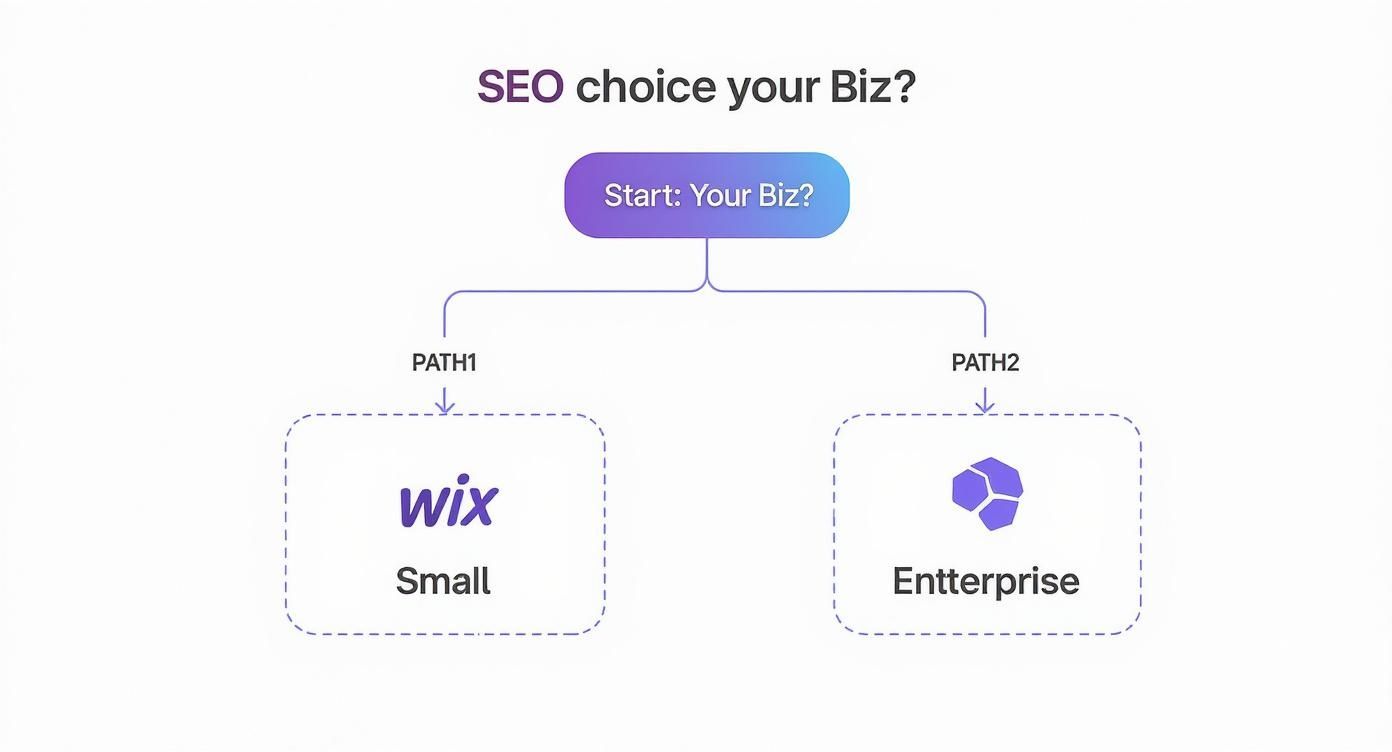
As the visual guide shows, the scale of your operation is one of the biggest factors here. It points you toward the platform that can not only meet your current needs but also support you as you grow.
Frequently Asked Questions
When you're weighing Drupal against Wix, a few common questions always seem to pop up. Getting clear on these points is crucial because it helps you look past the marketing and see which platform genuinely fits your project, both now and in the future.
These two platforms were built for completely different people, and that's the most important thing to remember. Their philosophies on everything from cost and security to how you actually build a page are fundamentally at odds. Let's dig into the details.
Can a Non-Developer Really Use Drupal?
Technically, yes, but it’s a tough road. A non-developer can definitely learn to manage content on an existing Drupal site—writing blog posts, updating pages—but that's about it. The platform’s real power isn't in a drag-and-drop interface; it's in its deep, developer-centric backend.
Actually building something or making significant changes requires getting your hands dirty with concepts like nodes, views, and modules. For anyone without a technical background, Drupal's learning curve feels less like a curve and more like a cliff. You'll almost certainly need a developer to get it off the ground.
Is Wix Cheaper Than Drupal?
At first glance, absolutely. Wix presents a simple, all-in-one monthly fee, which feels much more predictable. But the full picture is more complicated. The Drupal software itself is completely free. Your costs are tied to hosting, custom development work, and ongoing maintenance.
For a basic brochure site or a small portfolio, Wix will be the more affordable option, hands down. But if you're building a large, complex application with tons of traffic, a well-managed Drupal site can actually have a lower Total Cost of Ownership (TCO) over a few years. You escape the trap of rising subscription fees and gain more control over performance and resources.
It's not about the initial price tag; it's about long-term value. With Wix, you get predictable, bundled costs built for simplicity. With Drupal, you're making a scalable investment where you pay only for the exact resources and expertise your project demands.
Which Platform Is Better for a Small Business?
For most small businesses, Wix is the clear winner. Its entire model is built around speed, ease of use, and a predictable subscription that covers everything from hosting to security. It’s perfect for entrepreneurs or small teams who need a professional website live yesterday and don't have a developer on payroll.
The exception? A small business with a truly unique online business model, one that anticipates huge growth, or one that handles highly sensitive data. In those specific cases, Drupal can be the right foundation, but only if you have the budget to hire professional developers to build and maintain it properly.