how to increase blog traffic: proven tips & strategies
Discover how to increase blog traffic with actionable SEO tips, content strategies, and promotion ideas to grow your audience.


Growing your blog's readership isn't about finding a single magic bullet. It's a methodical process built on three core pillars: a rock-solid technical foundation, consistently great content that's optimized for search, and a smart promotion strategy. Nail these, and you create a powerful engine for attracting and keeping an audience.
Building Your Foundation for Traffic Growth
Before you even think about writing your first post, you need to lay the groundwork. It's a step too many aspiring bloggers skip in their excitement to just create, but it's the difference between a blog that gets a trickle of visitors and one that builds a steady, predictable flow of traffic. Getting the structure and strategy right from day one is your launchpad for long-term success.
Define a Niche with an Audience
One of the most common pitfalls I see is choosing a niche based purely on passion. Passion is great—it'll get you through the tough days—but a successful blog has to solve a real problem for a specific group of people.
Who are you actually writing for? What keeps them up at night? Your content's primary job is to be the answer they're looking for. When you get this right, you stop being just another blog and start becoming a trusted authority in your space, which makes attracting and retaining readers infinitely easier.
Establish Your Technical Bedrock
Let's be blunt: your blog's technical health is completely non-negotiable. A slow, clunky, or confusing website doesn't just annoy visitors—it gets you actively penalized by search engines. If you want to grow your traffic, you have to get the technical side right.
Here's what to focus on:
Choose the right platform: Your Content Management System (CMS) is the engine powering your entire site. For most bloggers, a self-hosted WordPress.org site is the gold standard because of its flexibility and powerful SEO capabilities. If you're weighing your options, diving into a detailed comparison of different CMS systems can help you find the perfect fit for your goals.
Make site speed a priority: In 2024, a slow website is a dead website. You should be aiming for a load time of under two seconds. Anything slower, and you're losing visitors before they even see your content.
Be relentlessly mobile-friendly: More than half of all internet traffic now comes from mobile devices. If your blog isn't easy to read and navigate on a phone, you're alienating the majority of your potential audience. A responsive design isn't optional; it's essential.
This image breaks down the core components of SEO, which is deeply intertwined with your technical foundation.

As you can see, technical factors, on-page content, and off-page authority all have to work in concert. If one leg of this stool is weak, the whole thing wobbles.
To put this into perspective, remember there are over 600 million blogs out there. Standing out requires a commitment to excellence on all fronts. Blogs that actively and consistently publish can see a staggering 434% increase in indexed pages, which is a direct pipeline to better search visibility and more organic traffic.
Before we move on, let's summarize the foundational elements that are crucial for sustainable traffic growth. These aren't just suggestions; they are the pillars that will support everything else you do.
Key Pillars for Sustainable Blog Traffic
| Element | Primary Impact | Why It's Critical |
|---|---|---|
| Defined Niche & Audience | Content Relevance & Authority | Without a clear audience, your content has no focus. This clarity allows you to become a go-to resource, which attracts loyal readers and backlinks. |
| Solid Technical SEO | Search Engine Visibility & User Experience | Search engines won't rank a slow or broken site. A good user experience keeps visitors on your page longer, sending positive signals to Google. |
| High-Quality Content | Engagement & Organic Traffic | This is the fuel for your entire strategy. Great content answers questions, solves problems, and naturally earns shares and links over time. |
| Consistent Promotion | Audience Reach & Brand Building | Even the best content needs a push. Promotion gets your work in front of new audiences and accelerates the growth of your readership. |
Getting these four pillars right from the start sets a powerful flywheel in motion, making every subsequent effort to grow your blog more effective.
Mastering SEO for Consistent Organic Traffic
Search engine optimization is the engine that drives a steady flow of high-intent visitors to your blog, long after you’ve hit publish. Forget the old-school tricks like keyword stuffing. Today's SEO is about creating content that genuinely helps people, which in turn, brings in that reliable organic traffic.
The whole process starts with figuring out what your audience is actually typing into Google. Don't guess. You need to base your content plan on solid keyword research. My advice is to look past the obvious, high-volume terms and dig into long-tail keywords. These are the longer, more specific phrases that signal exactly what a user wants to know.
For example, a new baking blog has little chance of ranking for "baking." But targeting "how to bake sourdough bread without a dutch oven"? That’s a different story. The search volume is lower, but the competition is manageable and the audience is far more engaged.
On-Page SEO The Right Way
On-page SEO is all about optimizing individual blog posts so they can rank higher. It's how you signal to search engines what your content is about while making it a great experience for the reader.
Here's where to focus:
- Compelling Titles and Meta Descriptions: Think of your title tag and meta description as your sales pitch in the search results. They need to be good enough to earn the click. Knowing how to improve Click Through Rates (CTR) and boost traffic is a critical skill for turning impressions into actual readers.
- Logical Post Structure: Use headings (H2s, H3s) to break up your content into logical sections. This doesn't just help search engines understand your article's structure; it makes it scannable and far more readable for people.
- Strategic Internal Linking: Whenever you publish a new post, look for opportunities to link to other relevant articles on your blog. This keeps readers on your site longer and passes authority between your pages. For instance, in a post about technical SEO, you could link out to a deeper dive on what https://www.contenttoolkit.co/blog/what-does-decoupled-mean for a site's performance.
Demystifying Off-Page SEO
Off-page SEO covers all the things you do outside of your website to improve your rankings. The biggest piece of this puzzle is building a healthy backlink profile. You can think of backlinks as votes of confidence from other websites.
Getting consistent traffic growth is getting tougher, though. In 2025, only 20% of bloggers reported getting "strong results," which is a drop from 30% just five years ago. This data really drives home the fact that traffic is the number one challenge for creators.
The best way to earn quality backlinks is to create "link-worthy" content. Think unique data, incredibly detailed guides, or useful tools that other people in your niche will naturally want to reference.
Building real relationships in your industry is also a powerful approach. Guest posting on reputable sites or working on collaborative projects can do wonders for your backlink profile.
To see if any of this is actually working, you'll live inside your Google Analytics dashboard. It’s essential for tracking your SEO efforts by showing you traffic sources and which pages are performing best.

This dashboard tells you exactly where your visitors are coming from. Armed with that knowledge, you can double down on the strategies that are working and rethink the ones that aren't. SEO is definitely a long-term game, but it's hands-down the most sustainable way to grow your blog's traffic.
Creating Content That Attracts and Engages

Let's be honest: all the technical SEO in the world won't matter if your content falls flat. Getting people to your blog is one thing, but keeping them there—and making them want to come back—is a whole different game. This is where your actual writing takes center stage.
The goal isn't just to publish articles; it's to create a go-to resource. That means ditching the random "write what I feel like" approach and building a real content strategy. You need a plan that signals your expertise to both your readers and the search engines that bring them to you.
Build Authority With Content Pillars
One of the most effective ways I've seen to organize content is the pillar and cluster model. It’s a powerful strategy that’s less complicated than it sounds.
You start by creating a massive, comprehensive article—your "pillar"—on a broad topic that's central to your niche. From there, you write shorter, more focused "cluster" posts that dive into specific subtopics, and each one links back to that main pillar.
Imagine you run a marketing blog. Your pillar post might be "The Ultimate Guide to Digital Marketing." Your cluster content would then branch out into related, specific topics:
- Email Marketing Best Practices for 2024
- A Beginner's Guide to Social Media Advertising
- How to Write SEO-Friendly Blog Posts
- Analyzing Your Website's Performance with Google Analytics
This structure does wonders for SEO by creating a dense web of internal links. It basically tells Google, "Hey, I'm an expert on this entire subject," which helps the whole group of articles rank higher. More importantly, it keeps readers on your site, guiding them from one helpful post to the next.
This interconnected approach transforms your blog from a simple collection of posts into a structured library of information. It establishes you as an authority and significantly improves the user experience by making it easy for readers to find comprehensive information.
Find a Sustainable Publishing Cadence
Consistency is king, but so is quality. I see so many bloggers burn out trying to publish new content every single day. The result is often a stream of short, shallow posts that don't really help anyone.
It’s far better to publish one truly excellent, in-depth article per week than five mediocre ones.
Find a rhythm you can actually stick with for the long haul. This gives you the breathing room to do proper research, thoughtful writing, and effective promotion for every piece you publish. That's how you build a reputation and an audience that trusts you.
The data backs this up. The trend is clearly moving toward longer, more substantial content. While the average blog post hovers around 1,394 words, analysis from Wix shows the ideal length for making a real traffic impact is closer to 2,450 words. This tells us loud and clear that readers (and search engines) prefer comprehensive, detailed articles.
Use AI Tools to Enhance Your Workflow
Artificial intelligence can be an incredible assistant, but it's a terrible author. The trick is to use it to support your expertise, not replace it. It’s no surprise that 80% of bloggers are now working AI into their process.
Instead of asking it to write an entire post, think of it as a tool for efficiency and research.
Here are a few smart ways to put AI to work:
- Brainstorming & Outlining: When you’re stuck, AI is great for generating topic ideas, potential subheadings, and a solid article structure.
- Research Assistance: Use it to quickly summarize complex studies or pull relevant statistics you can then verify.
- Refining Your Writing: It can help you improve clarity, catch grammatical mistakes, or rephrase a clunky sentence for better flow.
By using AI strategically, you can produce better content, faster, without losing your unique voice. This frees you up to focus on what really matters: your personal insights, storytelling, and connecting with your readers. And remember, having the right platform makes a huge difference. Our directory of powerful blogging CMS options can help you find the perfect system to manage it all.
Hitting 'Publish' is Just the Start
You’ve poured hours, maybe even days, into creating an amazing piece of content. It’s well-researched, insightful, and perfectly polished. But hitting that 'publish' button? That’s not the finish line. It’s the starting gun.
Without a smart promotion strategy, even the best article can end up sitting on a digital shelf, gathering dust. The real work of getting eyeballs on your content begins after it goes live. This is where you shift from creator to promoter, and it’s how you turn a small trickle of visitors into a reliable flood.
Start With Your Warmest Audience
Your email list is your single greatest promotional tool. Period. It's a direct line to your most dedicated followers—people who have explicitly asked to hear from you. No algorithm can get in the way.
Every time you publish something new, your subscribers should be the first to know. Sending them an email drives an immediate spike in high-quality traffic from people who are most likely to read, engage, and share. That initial burst of activity is a powerful signal to search engines. If you haven't already, focusing on strategies to build email lists that convert is a non-negotiable part of growing your readership.
Pro Tip: Never just send a link with the title. In your email, take a moment to explain why this post is worth their time and who it will help the most. A little context goes a long way and can dramatically boost your click-through rates.
A platform like Beehiiv can be your best friend here, giving you the tools to manage and grow that all-important list. If you’re exploring your options, our breakdown of the best features of Beehiiv can show you what’s possible.
Go Where Your Readers Already Are
Once you've alerted your core audience, it's time to venture out. The goal is to find the digital "watering holes" where your ideal readers are already hanging out. This isn't about dropping links and running; it's about becoming part of the conversation.
- Niche Forums and Subreddits: Dive into communities that live and breathe your topic. Look for questions you can answer with genuine expertise. When it makes sense and adds real value, you can link back to a post on your blog that offers a deeper dive.
- Social Media Groups: Join relevant groups on Facebook or LinkedIn. Don’t just post your own stuff. Engage with others, share your knowledge freely, and build a reputation. When you eventually share one of your articles, it's seen as a valuable resource from a community member, not a drive-by ad.
- Strategic Social Sharing: Don't just spray and pray across every platform. Figure out where your audience is most active and concentrate your efforts there. Craft your message for that specific network—a professional angle for LinkedIn, an eye-catching visual for Pinterest, or a quick, punchy thought for X (formerly Twitter).
By meeting your readers on their home turf, you’re not trying to create an audience from scratch. You’re tapping into a pre-built community of people who are already primed to be interested in what you have to say.
Using Analytics to Fuel Your Growth
Publishing content and never checking your analytics is basically flying blind. If you're serious about growing your readership, you have to stop guessing what works and start letting data guide your decisions. This means getting comfortable in tools like Google Analytics and Google Search Console.
These platforms are so much more than a place to glance at pageviews. The real magic happens when you start digging into the data to understand the story behind your traffic. You can see exactly how people find you, what content hooks them, and where you’re losing their attention.
Focusing on Actionable Metrics
It's incredibly easy to get overwhelmed by all the charts and numbers. Instead of trying to track everything, just focus on a few key metrics that give you clear, actionable insights for your content strategy.
These are the numbers that actually move the needle.
Traffic Sources: This metric answers the simple question: how are people finding my blog? Whether it’s organic search, social media, or referrals from another site, knowing where your audience comes from tells you which channels to double down on.
Top Performing Pages: You need to know your greatest hits. Pinpointing your most popular posts is like getting a direct report from your audience on what topics and formats they love. These are your proven winners.
User Engagement: Look at metrics like Average Engagement Time. This tells you if people are actually reading what you wrote. A low number here is a red flag that your content might not be hitting the mark or delivering on the promise of its headline.
This simple infographic breaks down how your core promotion channels—email, social, and communities—create the data you see in your analytics dashboard.
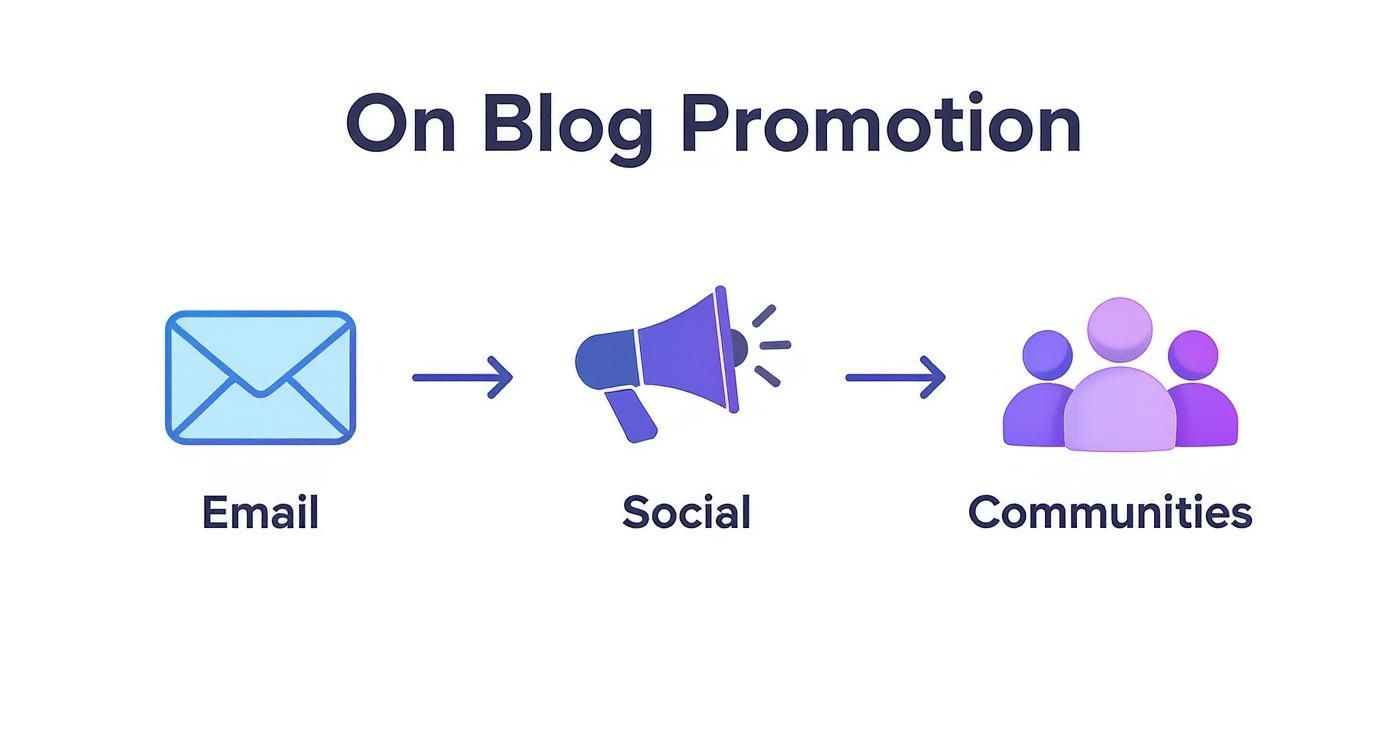
Every channel brings a slightly different kind of visitor. Your analytics will help you figure out which promotion efforts are actually delivering engaged readers, not just empty clicks.
Turning Insights into Action
Data is completely worthless if you don't do anything with it. The goal is to use what you learn to constantly refine your approach. For instance, if you notice a particular post is bringing in a ton of organic traffic, that's a massive signal from Google that you should build out a whole topic cluster around it.
The most successful bloggers treat their analytics not as a report card, but as a roadmap. It shows them where to go next, what to create, and how to serve their audience better.
This data-driven loop is what creates sustainable growth. You can spot old content that needs a refresh, uncover new keyword opportunities, and map out the entire user journey on your site. The process gets even more powerful when you start connecting data across your marketing stack; understanding how CMS and CRM platforms work together can give you an even richer view of your audience. When you let the data lead, you’re not just publishing content—you’re building a growth engine.
Common Questions About Increasing Blog Traffic
As you start putting these strategies into practice, you're bound to hit a few snags. Growing a blog audience isn't a straight line, and troubleshooting common issues is part of the process. Let’s tackle some of the most pressing questions that come up when you're trying to figure out how to drive more traffic.
Think of this as your go-to reference for those moments when you feel stuck or aren't sure what to do next.
How Long Does It Take to See Traffic Growth?
This is the big one, isn't it? The honest answer is, it's a marathon, not a sprint. If you're banking on organic search traffic from SEO, you're playing the long game. It often takes a good 6 to 12 months of consistent effort before you start seeing meaningful, steady traffic from search engines.
Initially, your wins will come from direct promotion—sharing new posts with your email list or on social media. That's where you'll see those early spikes.
But you can definitely speed things up. I've seen new blogs focusing on low-competition keywords, paired with a relentless promotion strategy on a platform like Pinterest, start getting real traction within 3 to 4 months. The trick is to have a marketing plan for every single article from the moment you hit "publish."
Don't fall into the "publish and pray" trap. For every article, you should know exactly who it's for and which channels you'll use to get it in front of them. Hope is not a traffic strategy.
Should I Write Fewer Long Posts or More Short Posts?
Quality trumps quantity, every single time. It's far better to publish one deeply researched, 2,000+ word article that completely solves a reader's problem than it is to churn out five short, surface-level posts. Both your readers and search engines reward depth and genuine authority.
Think about it: long-form content is just naturally more shareable and link-worthy. It becomes a go-to resource. While your own publishing schedule will depend on your resources, focusing on fewer, more substantial articles gives you the bandwidth to properly promote each one.
What Is the Most Important Metric to Track?
Pageviews are a great ego boost, but they don't tell you the whole story. The most powerful metric for real, actionable insight is Traffic Source. This data shows you what’s actually working.
- Lots of Organic Search Traffic? Great! Your keyword research and SEO efforts are paying off. Time to double down on that type of content.
- A big spike from Social Media? You’ve hit on a content style or platform that your audience loves. Let's see how you can replicate that success.
- Getting good Referral Traffic? A specific backlink or a mention in a community is sending people your way. That's a relationship worth nurturing.
When you know where your visitors are coming from, you can stop guessing. It allows you to invest your limited time and energy into the channels that are actually delivering results. Focusing on traffic sources transforms your analytics from a simple report card into a strategic roadmap.