The 12 Best CMS Headless Platforms for 2025
Discover the best CMS headless platforms for your project. Our in-depth guide compares 12 top options on features, pricing, and real-world use cases.

Choosing the best CMS headless platform is a critical decision that impacts developer productivity, content team workflows, and your project's future scalability. Unlike traditional systems, a headless architecture decouples content management from the front-end, delivering your content as data via an API. This provides the flexibility to build custom experiences with modern frameworks like React or Vue and distribute content across websites, mobile apps, and other digital channels simultaneously.
This newfound freedom, however, introduces a new set of critical evaluation points. Factors like API design (REST vs. GraphQL), developer experience, content modeling capabilities, and complex pricing models become paramount. Before diving into the specifics of headless solutions, understanding the broader landscape of Content Management Software for small businesses can provide valuable context for making the right choice.
This guide moves beyond marketing claims to offer a direct, analytical breakdown of the top headless CMS platforms. We will evaluate the practical strengths, honest limitations, and ideal use cases for each option to help you make a truly informed decision. Each entry includes detailed analysis, screenshots, and direct links to help you find the platform that best fits your specific technical and business requirements, whether you're a developer, marketer, or project manager.
1. Contentful: The Enterprise-Grade Leader
As a long-standing leader in the headless CMS market, Contentful provides a highly mature, API-first platform tailored for complex digital experiences. Its strength lies in structured content modeling and robust governance, making it an excellent choice for enterprises managing content across multiple teams, languages, and channels. Developers benefit from comprehensive REST and GraphQL APIs, well-maintained SDKs, and extensive documentation that accelerates integration.
The platform’s App Framework allows for deep customization, enabling teams to build bespoke editing experiences and integrate with virtually any third-party tool. Contentful Studio, its visual composition tool, further empowers marketing teams to build and orchestrate digital experiences without constant developer intervention. This balance of developer power and marketer autonomy is a key differentiator.
Key Details:
- Best For: Large organizations, multi-brand portfolios, and projects requiring complex workflows, localization, and robust governance.
- Pricing: Offers a free community tier for individual projects. Paid plans (Team, Premium) scale based on users, content types, and usage, with custom pricing for enterprise needs.
- Unique Feature: The App Framework and extensive marketplace provide unparalleled extensibility, allowing you to tailor the CMS to your exact operational needs.
Visit Contentful's website to learn more.
2. Strapi (Strapi Cloud): The Open-Source Powerhouse
Strapi has established itself as the leading open-source headless CMS, offering developers unparalleled flexibility and control. Built on Node.js, its core strength lies in its 100% JavaScript foundation, which allows for deep customization of the API, admin panel, and content schemas. This makes it a top choice for development teams who want to own their codebase and tailor the CMS precisely to their project’s needs. For teams who want to dive deeper into this ecosystem, our guide to open-source headless CMS platforms offers more insights.
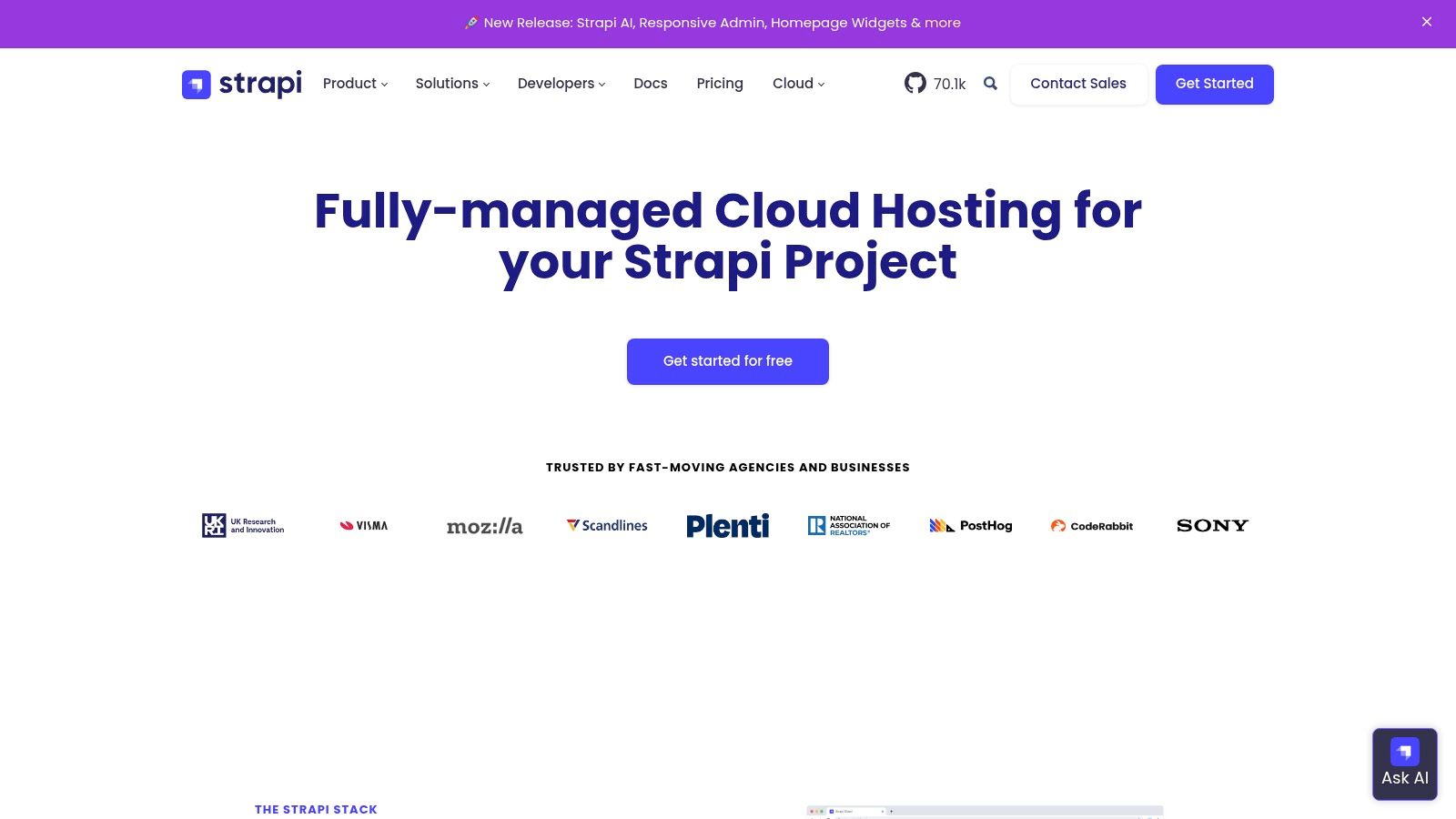
The introduction of Strapi Cloud provides a managed PaaS (Platform as a Service) option, removing the burden of self-hosting while retaining the benefits of the open-source core. This hybrid approach gives businesses a clear path to scale, starting with self-hosting for full control and migrating to the cloud for managed infrastructure. As an open-source platform, teams leveraging it might also explore various open-source documentation tool options to complement their development and internal knowledge bases. This makes it one of the best CMS headless options for versatile teams.
Key Details:
- Best For: Developers and teams who prioritize customization, self-hosting options, and a JavaScript-based ecosystem. Ideal for startups and mid-sized businesses.
- Pricing: The core software is free and open-source. Strapi Cloud offers a generous free tier, with paid plans (Pro, Team) scaling based on usage like API requests and bandwidth.
- Unique Feature: The hybrid model of a fully open-source, self-hostable core combined with a managed cloud platform offers ultimate flexibility for projects at any scale.
Visit Strapi Cloud's website to learn more.
3. Sanity: The Developer-Centric Content Platform
Sanity stands out in the headless CMS landscape by offering a developer-first experience centered on structured content and real-time collaboration. Its schema-as-code approach allows developers to define content models directly in their codebase, enabling powerful version control and streamlined workflows. This makes it an exceptional choice for modern web projects where agility and a tight developer feedback loop are critical. The platform is built around a real-time, hosted content backend called the Content Lake, which developers can query using the flexible GROQ language.
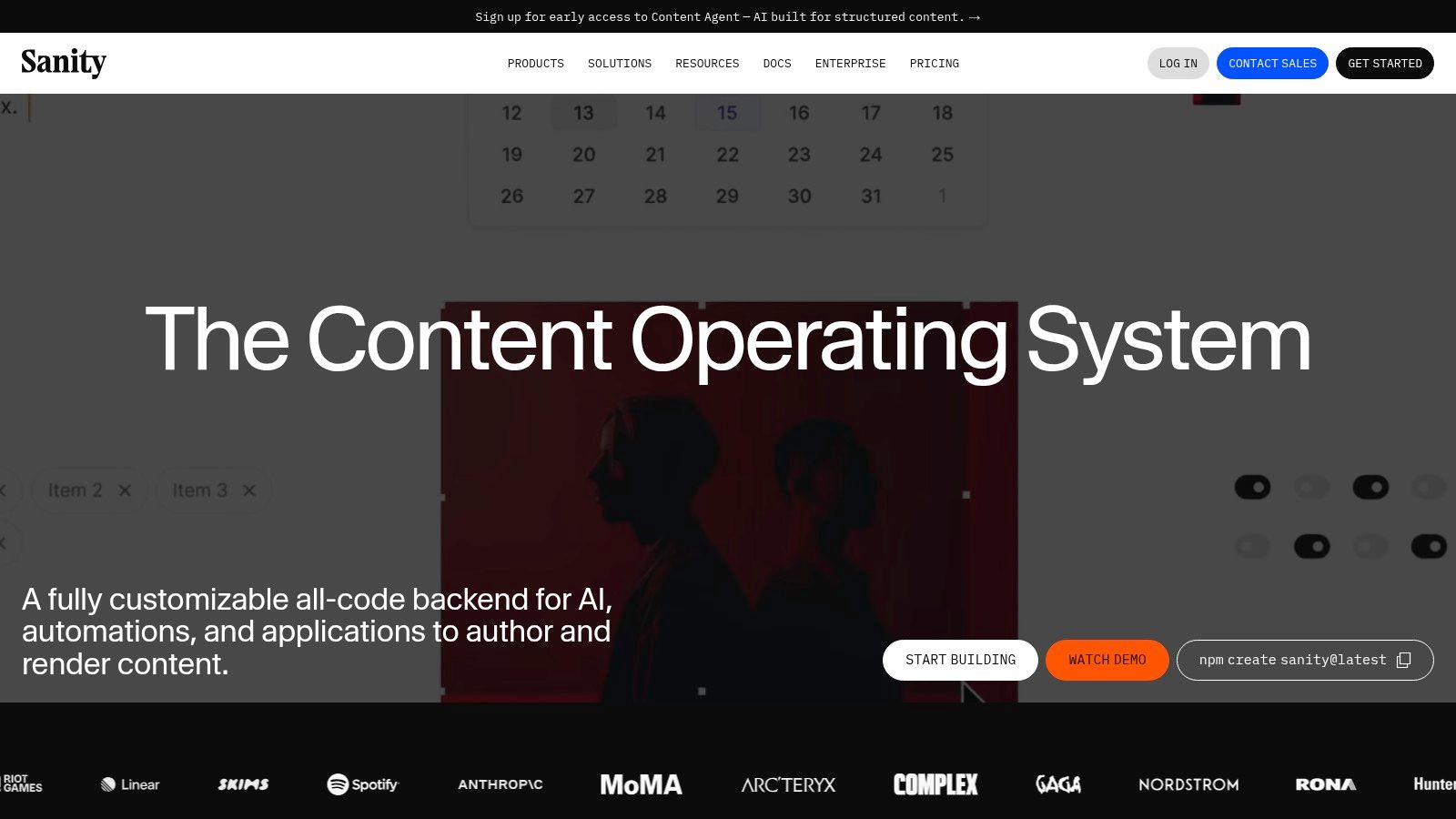
The open-source, React-based Sanity Studio is a major differentiator, offering a completely customizable editing interface that can be tailored to specific content models and workflows. This includes creating custom input components and integrating third-party tools directly into the editor. Its real-time preview capabilities are second to none, giving content creators instant feedback as they work. Sanity also provides powerful image transformation APIs and robust asset management, which you can explore further in this guide to digital asset management tools. This combination of developer control and content creator empowerment makes it one of the best headless CMS options available.
Key Details:
- Best For: Development teams that prioritize a schema-as-code workflow, projects requiring real-time content updates, and businesses needing a highly customized editing experience.
- Pricing: Offers a generous free tier with usage-based billing. Paid plans (Growth, Enterprise) provide higher quotas, more users, and advanced features.
- Unique Feature: The open-source and fully customizable Sanity Studio, combined with the powerful and flexible GROQ query language, offers developers unparalleled control and flexibility.
Visit Sanity's website to learn more.
4. Storyblok: The Visual Editor Powerhouse
Storyblok stands out in the headless CMS landscape by offering a best-in-class visual editing experience that bridges the gap between developer needs and marketer autonomy. Its real-time, component-based visual editor allows content teams to build and preview pages in a "what you see is what you get" environment, a feature often missing from other headless platforms. This approach empowers marketers to compose complex layouts without requiring developer support for every change.
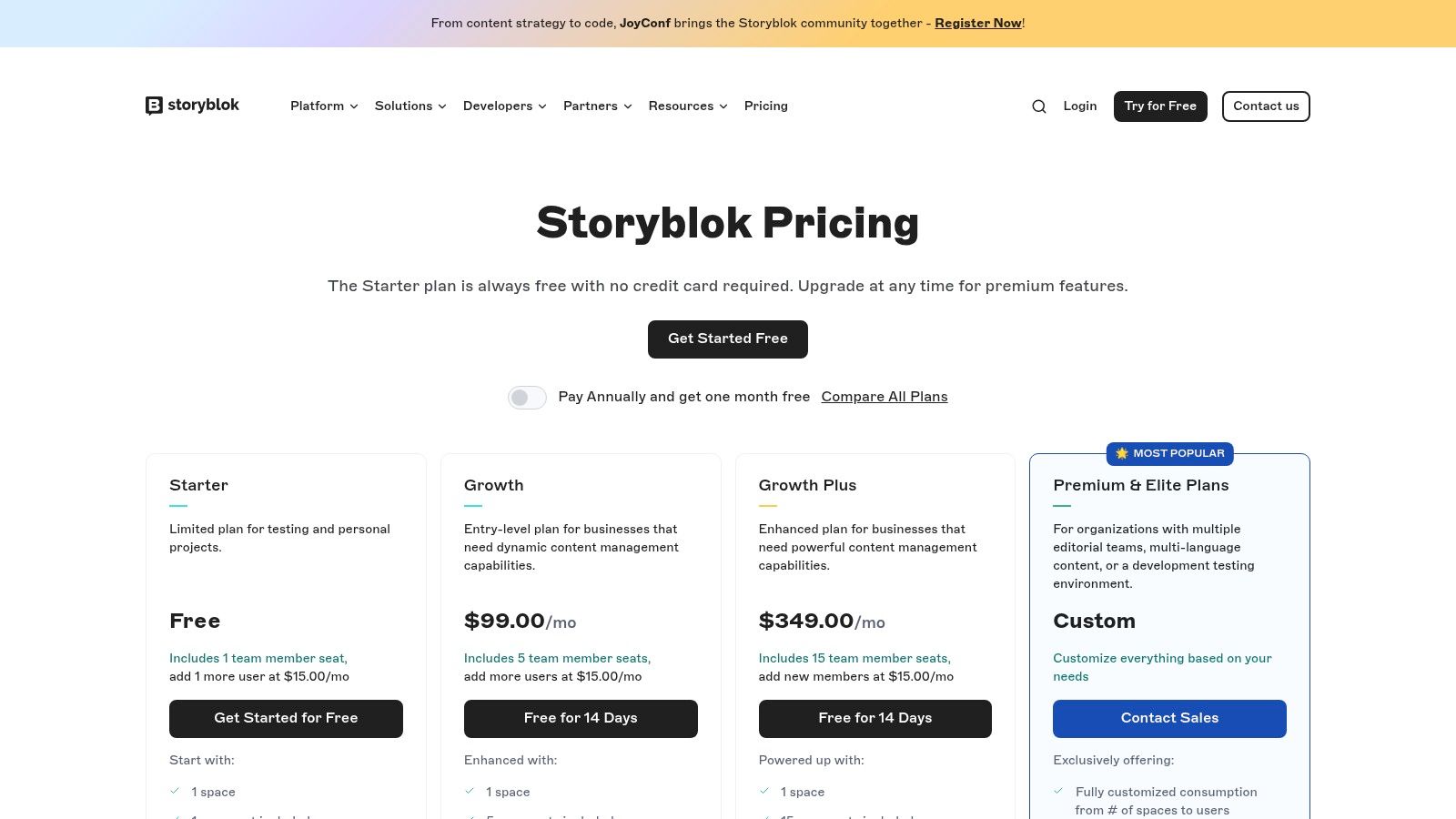
For developers, Storyblok provides flexible GraphQL and REST APIs, powerful image optimization services, and a component-based architecture that maps directly to modern frontend frameworks like React or Vue. While its traffic and API limits require monitoring for high-scale applications, the transparent pricing and approachable interface make it one of the best cms headless options for teams prioritizing a superior editorial experience. You can find more details about Storyblok in our headless CMS collection.
Key Details:
- Best For: Content-heavy marketing sites, e-commerce stores, and projects where editorial teams need strong visual control over page composition.
- Pricing: A free Community tier is available for development. Paid plans (Entry, Business, Premium) scale with usage, features, and user seats, offering clear overage pricing.
- Unique Feature: The Visual Editor is the core differentiator, providing a live preview and component-based editing that makes content management intuitive for non-technical users.
Visit Storyblok's website to learn more.
5. Hygraph (formerly GraphCMS): The GraphQL-Native Federation Hub
Hygraph positions itself as a GraphQL-native federated content platform, excelling in unifying content from disparate sources into a single, queryable API. It is an ideal choice for developers building modern, composable architectures who want to leverage the full power of GraphQL. The platform is designed to connect not only its own managed content but also data from third-party services like ERPs, PIMs, or other legacy systems, making it a powerful content hub.
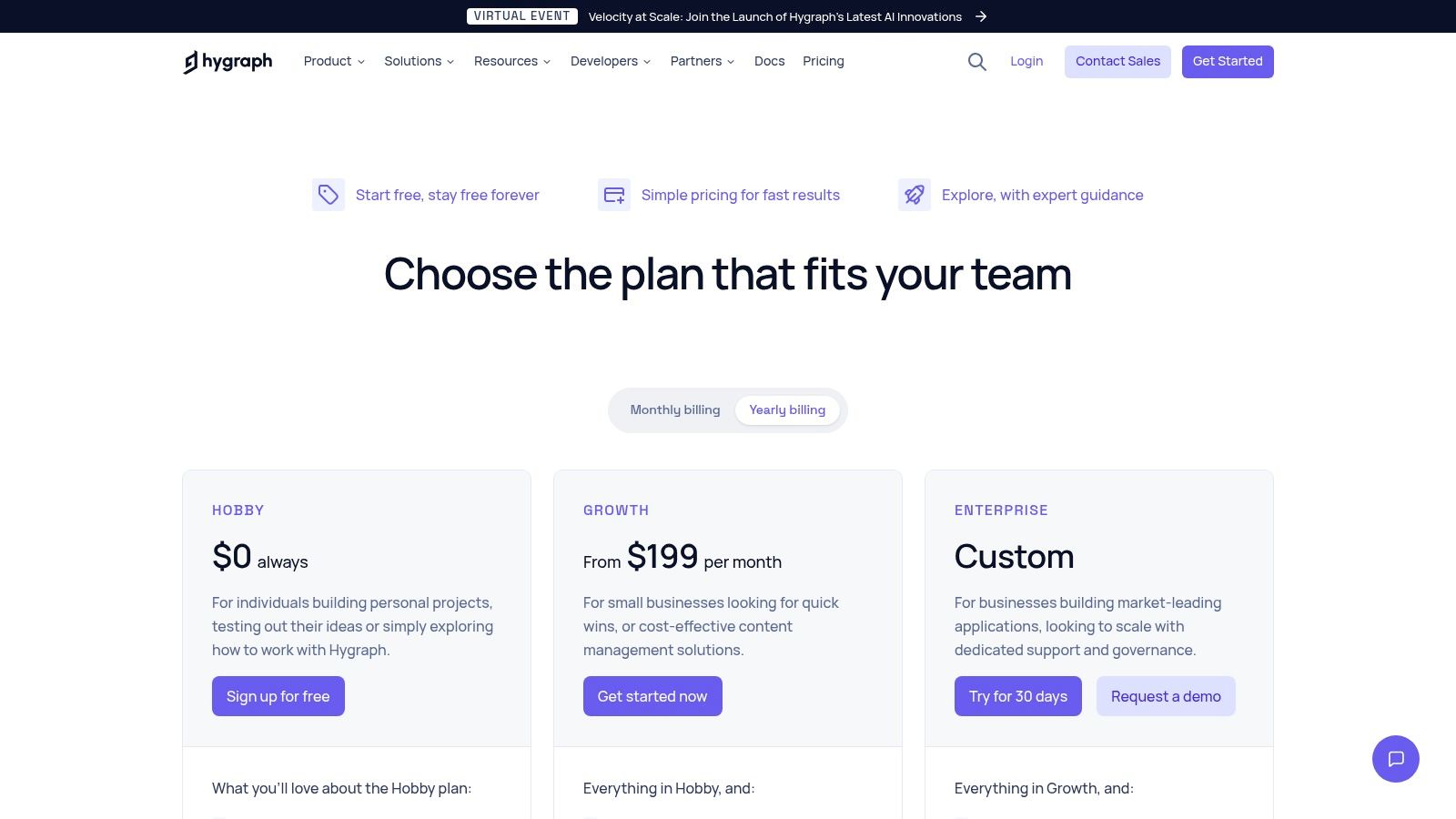
This focus on content federation makes it a standout option for complex digital products that need to aggregate data seamlessly. Developers appreciate its robust schema tooling, webhooks, and granular permissions, which provide excellent control over the content model and its delivery. For organizations looking to future-proof their stack and avoid being locked into a monolithic system, Hygraph offers a flexible and scalable foundation, solidifying its place among the best CMS headless solutions for federated content.
Key Details:
- Best For: Developer-led teams building composable architectures, projects requiring content federation, and anyone prioritizing a GraphQL-first workflow.
- Pricing: A generous free "Hobby" tier is available for personal projects. Paid plans (Professional, Scale) are based on usage metrics, with custom pricing for enterprise federation and governance features.
- Unique Feature: Content Federation allows you to create a single GraphQL API that seamlessly combines content managed in Hygraph with data from any remote API source.
Visit Hygraph's website to learn more.
6. Prismic: The Component-Driven Page Builder
Prismic has carved out a niche as a headless CMS that excels at empowering marketing teams and accelerating website development through its component-based architecture. Its standout feature is the Slice Machine, which allows developers to create reusable content sections ("Slices") that marketers can then assemble visually in the Page Builder. This approach strikes a powerful balance, giving developers control over the code while providing non-technical users the freedom to build and iterate on pages quickly.
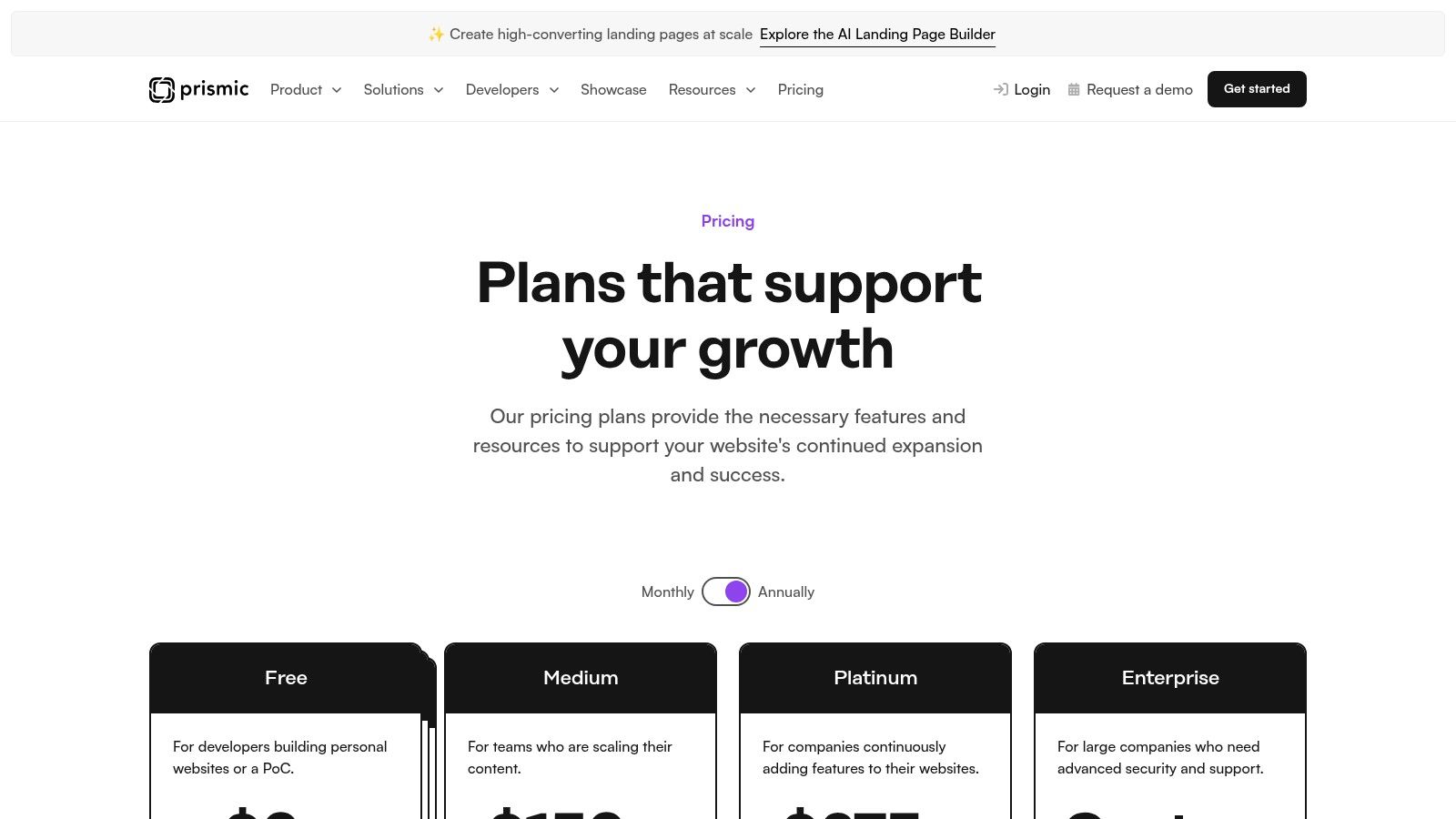
This makes Prismic a compelling choice for content-rich websites like marketing sites, blogs, and portfolios where speed and flexibility are paramount. The platform offers both REST and GraphQL APIs, ensuring it can integrate with modern front-end frameworks like Next.js and Nuxt. While advanced features such as dedicated environments and complex roles are reserved for higher-tier plans, its core offering is one of the most intuitive solutions for teams looking to launch quickly without extensive developer dependency.
Key Details:
- Best For: Marketing teams, agencies, and developers building content-heavy websites that require rapid iteration and a visual editing experience.
- Pricing: A generous free tier is available for individuals. Paid plans (Starter, Small, Medium, etc.) scale with users and features, offering predictable pricing per repository.
- Unique Feature: The Slice Machine and visual Page Builder provide a best-in-class component-based editing experience that bridges the gap between developers and content creators.
Visit Prismic's website to learn more.
7. Kontent.ai: The Governance-First Enterprise Platform
Spun out from Kentico, Kontent.ai is an enterprise-grade headless CMS built with a strong focus on content governance, workflow orchestration, and scalability for large, global teams. Its core strength lies in providing a highly structured and secure environment where complex content operations can be managed with precision. Developers are equipped with robust REST and GraphQL APIs, webhooks, and comprehensive SDKs that simplify integrations and ensure reliable content delivery.
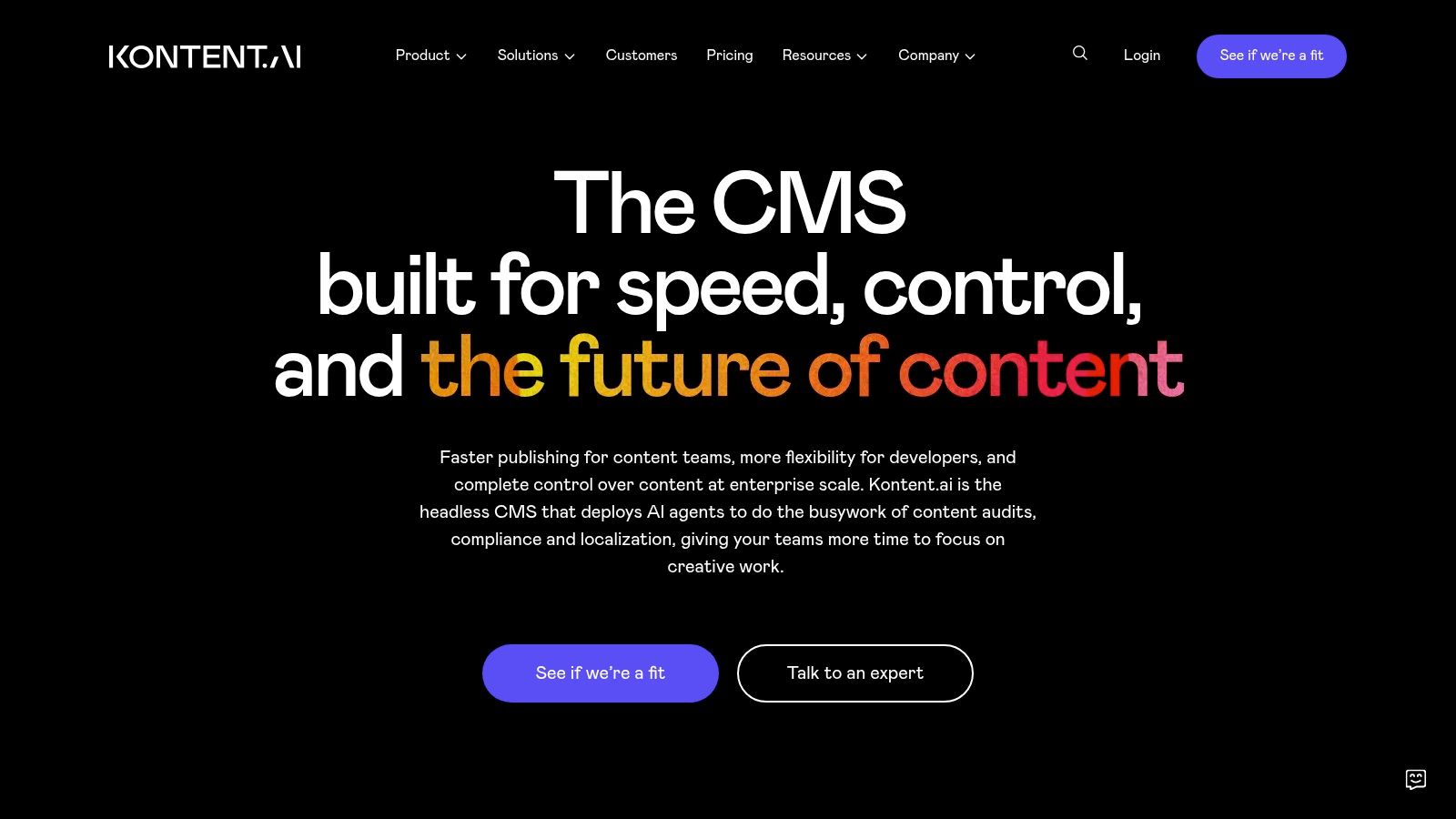
The platform empowers content teams with sophisticated features like customizable workflows, rich taxonomy management, and granular roles and permissions. This allows organizations to enforce brand consistency and compliance across all digital properties without creating bottlenecks. For businesses that need a mature, battle-tested solution with enterprise-level support and SLAs, Kontent.ai stands out as one of the best CMS headless options available, prioritizing control and operational efficiency above all else.
Key Details:
- Best For: Global enterprises, highly regulated industries, and organizations requiring strict content governance, complex approval workflows, and multi-locale management.
- Pricing: A free Developer plan is available with some resource caps. Paid Business and Premium plans offer custom pricing based on usage, with Enterprise plans providing premium support and SLAs.
- Unique Feature: Its Enterprise-Grade Governance is a key differentiator, offering exceptionally deep control over content workflows, user roles, and taxonomy, which is critical for large-scale, distributed teams.
Visit Kontent.ai's website to learn more.
8. Directus: The Open-Source Data Platform
Directus stands apart by positioning itself not just as a headless CMS, but as an open-source data platform. Its core function is to provide a beautiful, no-code admin interface on top of any new or existing SQL database. This "database mirroring" approach gives developers extreme flexibility, turning complex data schemas into fully accessible content through instant REST and GraphQL APIs without altering the underlying data.
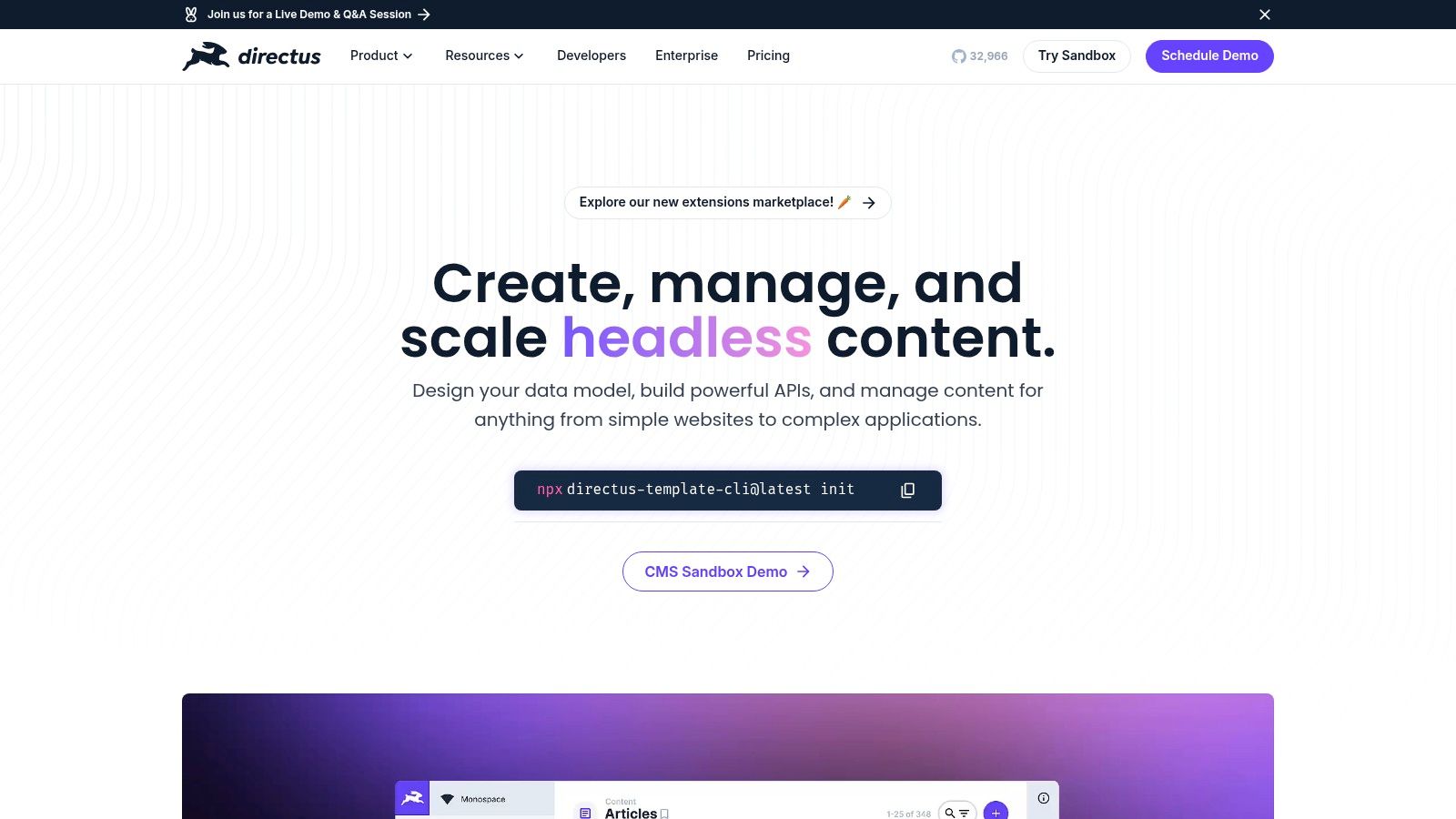
This makes it an incredibly powerful solution for projects that need to manage content living alongside application data in the same database. Because it is unopinionated about your schema, Directus adapts to your data model rather than forcing you into a specific structure. The active community and rapid development cycle ensure the platform stays modern, while its availability as a self-hosted solution or managed cloud service provides options for teams of all sizes. For those seeking one of the best CMS headless options that prioritizes data control, Directus is a top-tier choice.
Key Details:
- Best For: Developers wanting to wrap an existing SQL database with a CMS, data-heavy applications, and teams looking for an open-source, self-hostable solution.
- Pricing: A free, self-hosted Community Edition is available. Directus Cloud offers a free tier for small projects, with paid plans scaling based on usage and features.
- Unique Feature: Its ability to introspect an existing SQL database and instantly generate a no-code admin panel and API suite is unparalleled, offering a unique bridge between data management and content delivery.
Visit the Directus website to learn more.
9. ButterCMS: The Frictionless Content Hub
ButterCMS positions itself as a fast and intuitive headless CMS, ideal for marketing teams and developers who need to launch content-driven projects quickly. Its core strength lies in its simplicity and polished editorial interface, which includes visual editing, live previews, and built-in SEO tools. This focus on user experience allows content creators to manage blogs, case studies, and marketing pages with minimal training or developer dependency.
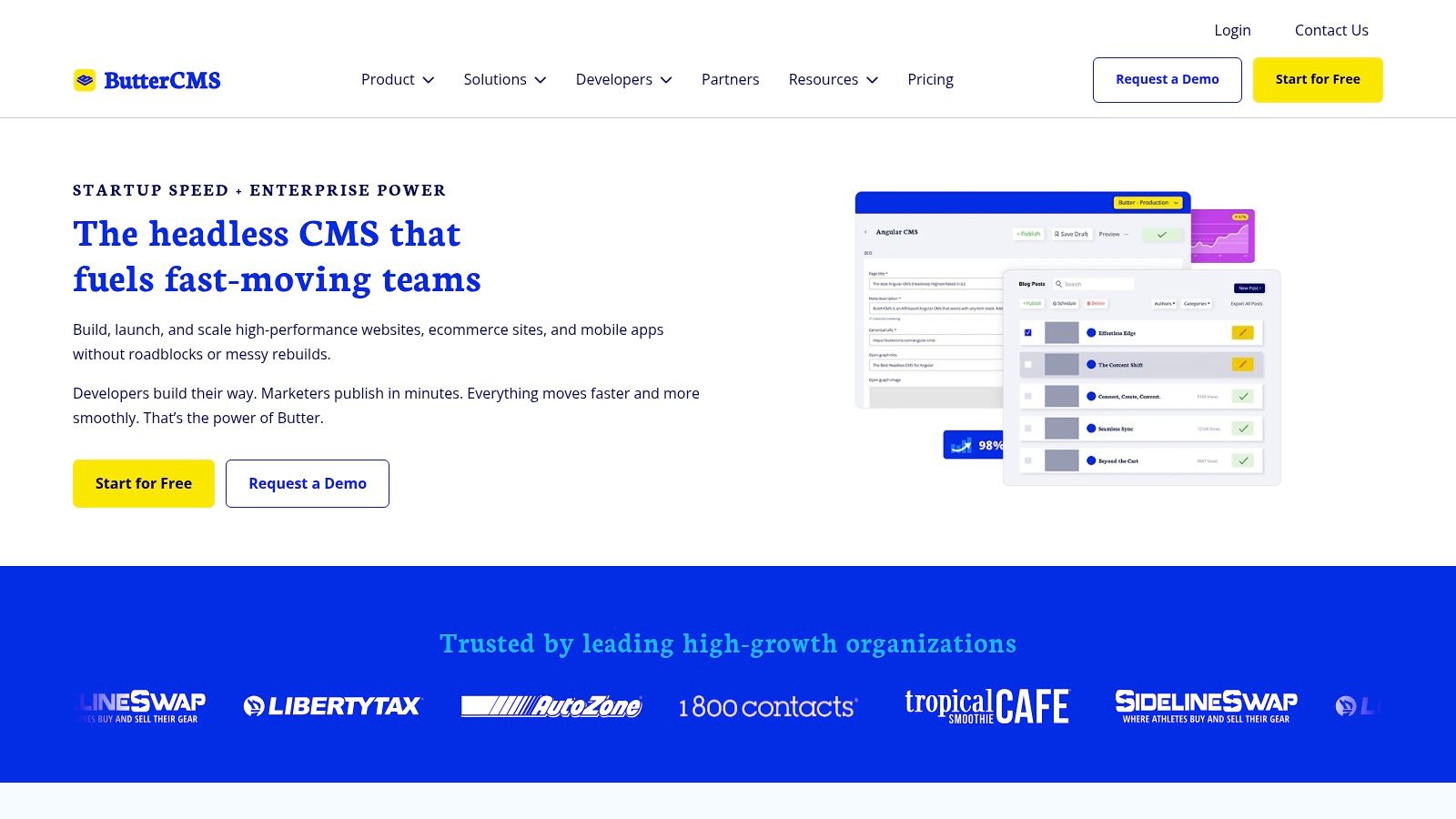
The platform is a strong contender in the best cms headless category for teams prioritizing predictable costs and ease of implementation. Developers appreciate the straightforward API and helpful SDKs, while the built-in AI assistant can help accelerate content creation workflows. Unlike many competitors that charge per seat, ButterCMS offers unlimited users on its paid plans, making it a financially attractive option for growing content and marketing departments.
Key Details:
- Best For: Marketing websites, blogs, and SMBs that need a user-friendly editor and predictable pricing for large content teams.
- Pricing: A free plan is available for development. Paid plans (Micro, Startup, Small Business, Enterprise) scale based on API calls and assets, not user seats.
- Unique Feature: Its unlimited user seats on all paid plans removes a common scaling barrier, simplifying budget approvals and making it accessible for entire organizations.
Visit ButterCMS's website to learn more.
10. Agility CMS: Bridging Content and Page Management
Agility CMS carves a unique niche in the headless CMS market by blending the flexibility of an API-first architecture with the familiar structure of traditional page management. This hybrid approach is particularly powerful for organizations that need granular control over website sitemaps and page composition directly within the CMS, a feature often missing from purely model-driven platforms. It empowers marketing and content teams to manage not just the content, but the structure of their digital properties.
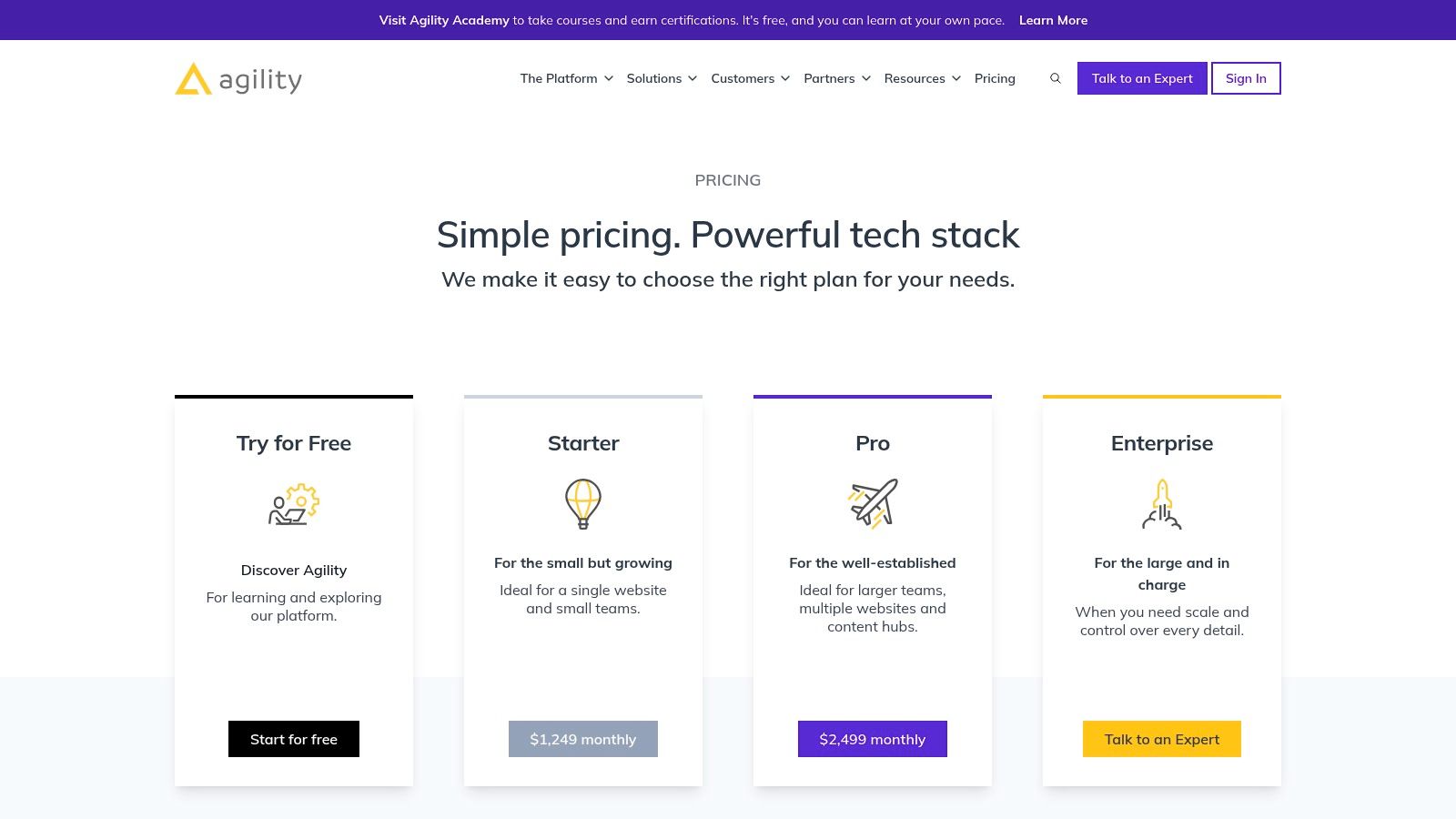
The platform is engineered for enterprise-level demands, offering robust features like content workflows, user permissions, and dedicated environments for development and staging. Its strength in managing multi-site and multi-team environments makes it a solid contender for companies with complex digital portfolios. For developers looking for one of the best CMS headless options that still provides structured page-level context, Agility CMS offers a compelling and practical solution that doesn't sacrifice enterprise-grade support.
Key Details:
- Best For: Marketing teams, large businesses with multiple websites, and organizations that want headless flexibility without giving up traditional page and sitemap management.
- Pricing: Starts with a free developer plan. Paid tiers (Pro, Enterprise) are based on content, users, and API calls, with custom pricing for enterprise needs including SLAs.
- Unique Feature: The built-in Page Management allows non-technical users to compose pages, manage sitemaps, and control the overall site structure, directly bridging the gap between content and its presentation layer.
Visit Agility CMS's website to learn more.
11. Builder.io: The Visual Headless CMS
Builder.io carves out a unique niche in the headless CMS landscape by merging a powerful visual editor with AI-assisted, design-to-code tooling. It’s designed to empower marketing and non-technical teams to build, publish, and iterate on digital experiences directly within a drag-and-drop interface that connects seamlessly to modern front-end frameworks like React, Vue, and Qwik. This approach dramatically reduces the dependency on developer cycles for routine content and layout updates.
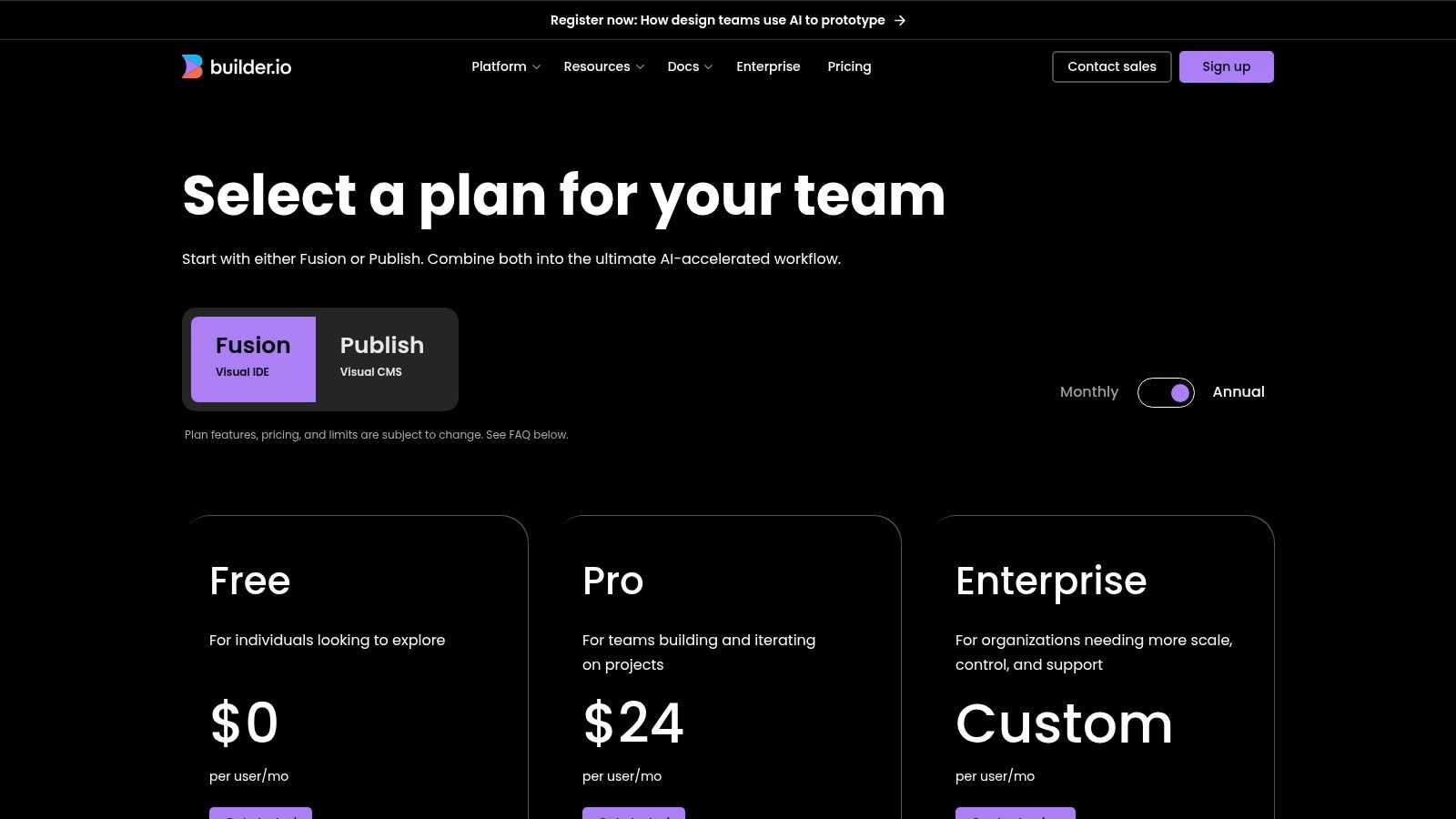
The platform's strength is its component-driven architecture. Developers define reusable content blocks or components in their codebase, which are then made available in the visual editor for business users to assemble into pages. This maintains brand consistency and technical integrity while granting autonomy to content creators. Its ability to convert Figma designs directly into clean code further streamlines the workflow between design and development, making it one of the best cms headless options for teams focused on rapid, high-fidelity execution.
Key Details:
- Best For: E-commerce and marketing teams that need to rapidly build and A/B test landing pages, promotional sections, and other visual components without requiring developer intervention for every change.
- Pricing: A generous free tier is available for small projects. Paid plans are tiered based on features, traffic, and user seats, with separate pricing for its different product offerings.
- Unique Feature: The Visual Copilot and design-to-code workflow, which uses AI to translate designs (like Figma) into framework-native code, significantly accelerating development and bridging the gap between design and implementation.
Visit Builder.io's website to learn more.
12. Cosmic: The Flexible, Add-On-Powered CMS
Cosmic offers a uniquely flexible approach to the headless CMS space, positioning itself as a managed SaaS solution that grows with your team's needs. Instead of locking essential features into high-tier plans, Cosmic provides a core platform with optional "Add-ons" for functionality like localization, revision history, and automated backups. This allows teams to tailor their environment precisely, paying only for the advanced features they actually use.
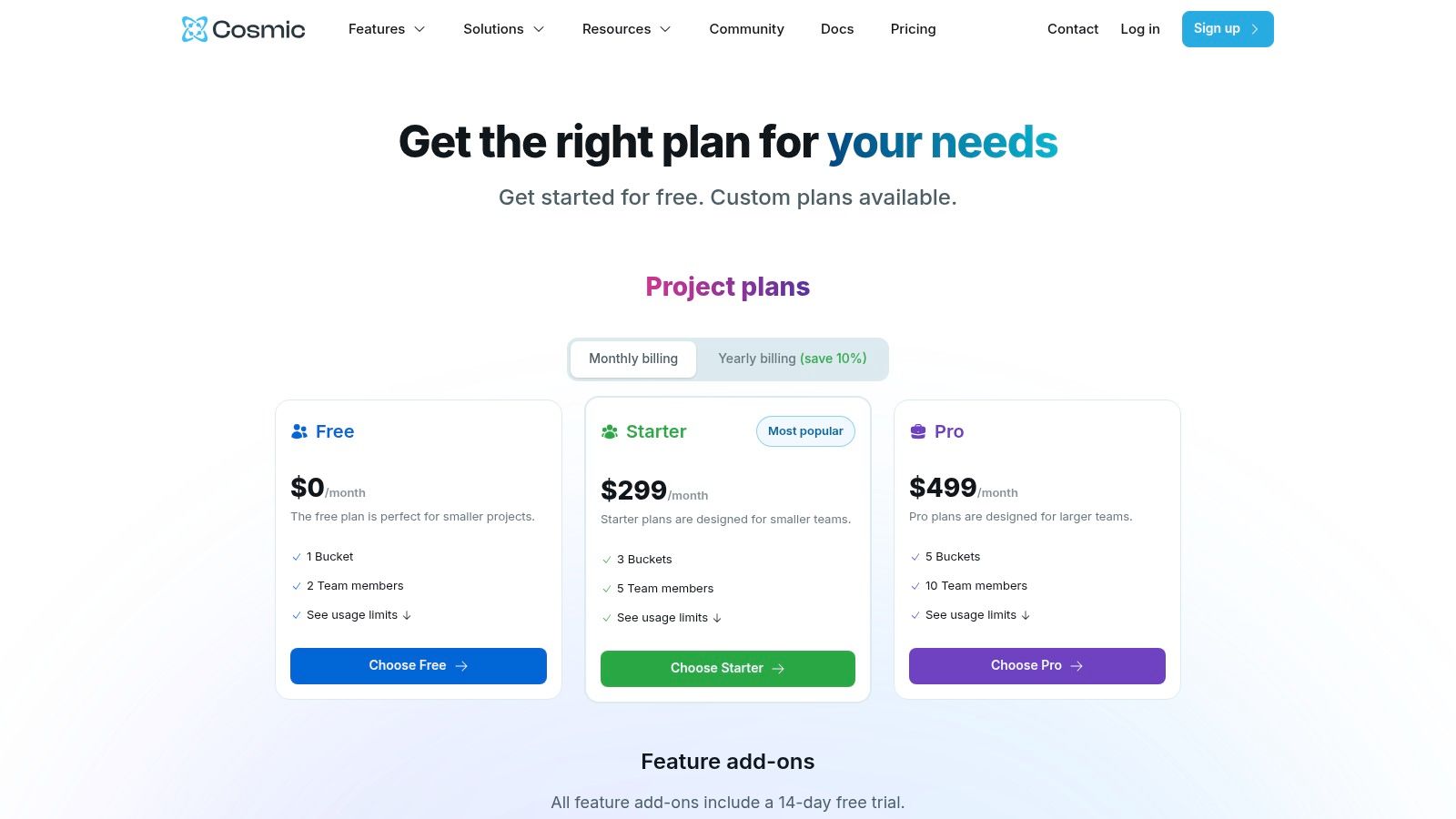
This model makes it one of the best cms headless options for teams that want a straightforward, managed service without the complexity of enterprise-level platforms. Developers get access to both REST and GraphQL APIs for seamless integration, while content teams benefit from an intuitive interface. The availability of optional AI token packs and dedicated migration assistance further simplifies the adoption process for businesses looking to scale their content operations efficiently.
Key Details:
- Best For: Startups, agencies, and mid-sized businesses that need a managed headless CMS with the flexibility to add specific features as they grow.
- Pricing: Offers a free plan for personal projects. Paid plans (Starter, Pro, Enterprise) are based on users and resource quotas, with Add-ons available for an extra monthly fee.
- Unique Feature: Its Add-on system allows for granular feature customization, letting you build a powerful CMS without being forced into a higher-priced tier for a single capability.
Visit Cosmic's website to learn more.
Top 12 Headless CMS Comparison
| Tool | ✨ Core features | ★ UX / Quality | 💰 Value & Pricing | 👥 Target audience | 🏆 Best for / USP |
|---|---|---|---|---|---|
| Contentful | REST & GraphQL APIs, RBAC, workflows, app marketplace | ★★★★ enterprise-grade docs & SLAs | 💰 Mid–High; usage scales cost | 👥 Enterprises, multi-team projects | 🏆 Governance, integrations & scale |
| Strapi (Strapi Cloud) | Open-source core, REST/GraphQL, plugins, managed cloud | ★★★★ very developer-friendly & customizable | 💰 Free tier; low entry hosting; usage limits | 👥 Dev teams wanting self‑host or managed | 🏆 Open-source flexibility & low-cost entry |
| Sanity | Schema-as-code, real-time APIs, GROQ, customizable Studio | ★★★★ excellent dev DX & real-time preview | 💰 Free→Growth; some pricing in-app | 👥 Developers building dynamic apps | 🏆 Real-time content + customizable Studio |
| Storyblok | Visual Editor, component-based content, GraphQL | ★★★★ very approachable for editors | 💰 Free tier; transparent consumption & overages | 👥 Marketers & editorial teams | 🏆 Best-in-class visual editor for headless |
| Hygraph | GraphQL-native APIs, content federation, versioning | ★★★★ high performance & dev ergonomics | 💰 Free Hobby; Growth pricier | 👥 Teams needing GraphQL-first & federation | 🏆 GraphQL-first content federation |
| Prismic | Slice model, visual page builder, CDN/APIs | ★★★★ fast for marketing pages & iteration | 💰 Mid-market; per-repo pricing & overages | 👥 Marketing teams & landing pages | 🏆 Slice-based page building & speed |
| Kontent.ai | Governance, workflows, multi-locale, REST/GraphQL | ★★★★ governance-focused & enterprise support | 💰 Enterprise pricing; public details limited | 👥 Large/global organizations | 🏆 Governance-first enterprise CMS |
| Directus | No-code admin over SQL, REST & GraphQL, self‑host/cloud | ★★★★ extremely flexible; community-driven | 💰 Self-host free; low-cost starter cloud | 👥 Teams exposing existing SQL schemas | 🏆 Direct SQL-first flexibility |
| ButterCMS | Managed SaaS, visual editing, unlimited users on paid plans | ★★★★ polished editor & quick setup | 💰 Predictable pricing; no seat fees | 👥 Blogs, marketing & ecommerce teams | 🏆 No-seat pricing & fast implementation |
| Agility CMS | Page management, sitemaps, roles, multi-site tools | ★★★★ strong multi-site UX; enterprise SLAs | 💰 Higher starting monthly price | 👥 Multi-site teams & enterprises | 🏆 Built-in page management + headless |
| Builder.io | Visual editor, design-to-code, AI-assisted tooling | ★★★★ enables non-dev publishing & iteration | 💰 Free tier; pricing/editions can be opaque | 👥 Designers, marketers & devs working together | 🏆 AI-assisted visual build & integration |
| Cosmic | Buckets/projects, REST/GraphQL, add-ons (locales/backups) | ★★★ simple, managed with flexible add-ons | 💰 Clear pricing grid; add-ons cost extra | 👥 Teams wanting managed CMS with add-ons | 🏆 Simple plans + modular add-ons |
Making Your Final Decision: Matching a CMS to Your Workflow
Navigating the landscape of headless content management systems reveals a clear truth: there is no single "best cms headless" platform. Instead, the optimal choice is deeply intertwined with your project's specific requirements, your team's technical expertise, and your long-term scalability goals. This guide has dissected twelve leading contenders, from enterprise-grade powerhouses like Kontent.ai to developer-centric toolkits like Sanity and Strapi. The key takeaway is that the right CMS acts as a strategic partner, not just a content repository.
The decision-making process hinges on identifying your core priorities. Is your primary goal to empower marketers with visual editing capabilities? In that case, Storyblok and Builder.io, with their component-based visual editors, offer a significant advantage. Are you a developer-led team that values ultimate flexibility and a customizable studio environment? Sanity's content lake and real-time collaboration tools would be a strong fit. For those seeking an open-source solution with full data ownership and extensive customization, Strapi and Directus provide powerful, self-hostable alternatives.
A Practical Framework for Selection
To move from analysis to action, consider a structured evaluation process. Begin by mapping out your essential content models and API requirements. Does your project rely heavily on GraphQL's precision, making a platform like Hygraph a natural choice, or is a flexible REST API sufficient?
Next, evaluate the total cost of ownership beyond the subscription fee. Consider factors like:
- Developer Onboarding: How steep is the learning curve for your team? A platform with robust documentation and an active community, like Strapi, can reduce ramp-up time.
- Editor Experience: Will your content team be able to work efficiently? Platforms like ButterCMS and Prismic prioritize a clean, intuitive user interface for non-technical users.
- Scalability and Performance: Assess the API response times and infrastructure. A globally distributed content delivery network, a core feature of platforms like Contentful and Agility CMS, is critical for international audiences.
- Integration Ecosystem: How easily does the CMS connect with your existing marketing automation, e-commerce, and analytics tools? Look for robust webhook support and pre-built integrations.
Your Next Steps
The final step is to validate your choice with hands-on testing. Nearly every platform discussed offers a free tier or a trial period. Create a small proof-of-concept project that mirrors your core use case. Set up a content model, invite a content editor to create and publish an entry, and have a developer fetch and render that content in a frontend prototype. This practical exercise will reveal more about a platform's workflow and limitations than any feature list ever could.
Choosing the best cms headless platform is a foundational decision that will influence your digital velocity for years. By aligning your team's needs with the unique strengths of these powerful tools, you can build a flexible, future-proof digital architecture that empowers every member of your team to create exceptional experiences. The perfect solution is out there; your task is to match its capabilities to your ambition.