Content Strategy for Small Business: Proven Tips to Grow
Learn effective content strategy for small business. Discover actionable steps and real-world examples to attract customers and boost growth.


A powerful content strategy is so much more than just randomly posting on social media and hoping for the best. For a small business, it's a documented game plan that connects every single piece of content you create back to a specific business goal. This whole process hinges on truly understanding your customer, knowing what success actually looks like, and picking the right places to share your content so you're not wasting effort from day one.
Building Your Foundational Content Strategy
I've seen so many small businesses jump straight into content creation, thinking that more is always better. That "spray and pray" approach almost always leads to burnout and, frankly, pretty disappointing results. A documented strategy is your roadmap; it ensures every blog post, video, or tweet serves a real purpose. Without that foundation, even the most brilliant content can fall flat and fail to deliver any return.
Define Your Business Goals First
Before you even think about blog topics or keywords, you have to answer a critical question: What are you actually trying to achieve with your content? The answer to this will shape every other decision you make. Vague goals like "get more traffic" just won't cut it. You need to get specific and focus on measurable outcomes that really impact your bottom line.
A few common, and much better, goals include:
- Generating Qualified Leads: This is about attracting potential customers who have a genuine interest in what you offer and then guiding them into your sales process.
- Increasing Brand Awareness: It's all about making your business more visible and a familiar name within your specific market.
- Improving Customer Retention: This means providing real value to your current customers to build loyalty and keep them coming back.
A classic mistake is trying to do everything at once. My advice? Pick one primary goal and maybe one secondary goal to start. That focus keeps your efforts from getting scattered and makes it so much easier to create content that actually moves the needle.
Get Specific About Your Ideal Customer
Once your goals are locked in, you need to get crystal clear on who you're talking to. Basic demographics are just the start—you have to go deeper. The goal is to build a detailed, almost living picture of your ideal customer. What are their biggest headaches and challenges? What gets them motivated? Where do they hang out online to find information? For a deeper dive into building this out, consulting a comprehensive content marketing strategy guide can provide a robust framework.
This level of detail is what allows your content to speak directly to their needs, making it feel personal and much more compelling. It’s the difference between shouting into an empty room and having a real conversation. This is especially critical when you consider that only 29% of marketers feel their documented strategy is highly effective, a failure that often comes down to fuzzy goals or a poor understanding of the customer's journey.
It's also a great idea to keep all this customer information organized and in one central spot. Using a tool like a knowledge base CMS can help your whole team store and pull up these customer personas, ensuring everyone is on the same page about who you're creating for. Find out more about them at: https://www.contenttoolkit.co/collections/knowledge-base-cms.
Choosing the Right Channels and Content Formats
It’s easy to feel like you need to be on every single platform, all at once. That's a classic small business trap. The truth is, a focused strategy on just a few key channels will always beat a scattered presence across ten. Your time and budget are finite—don't waste them where your customers aren't hanging out.
The whole game is about matching your channels to your business goals and where your audience actually lives online. A local bakery, for example, will get huge mileage out of a visually-driven platform like Instagram to show off daily specials and build a neighborhood vibe. On the flip side, a B2B software company will likely find its best leads by publishing deep-dive articles on its blog and getting active on LinkedIn.
Think of it like this—it all starts with your audience.
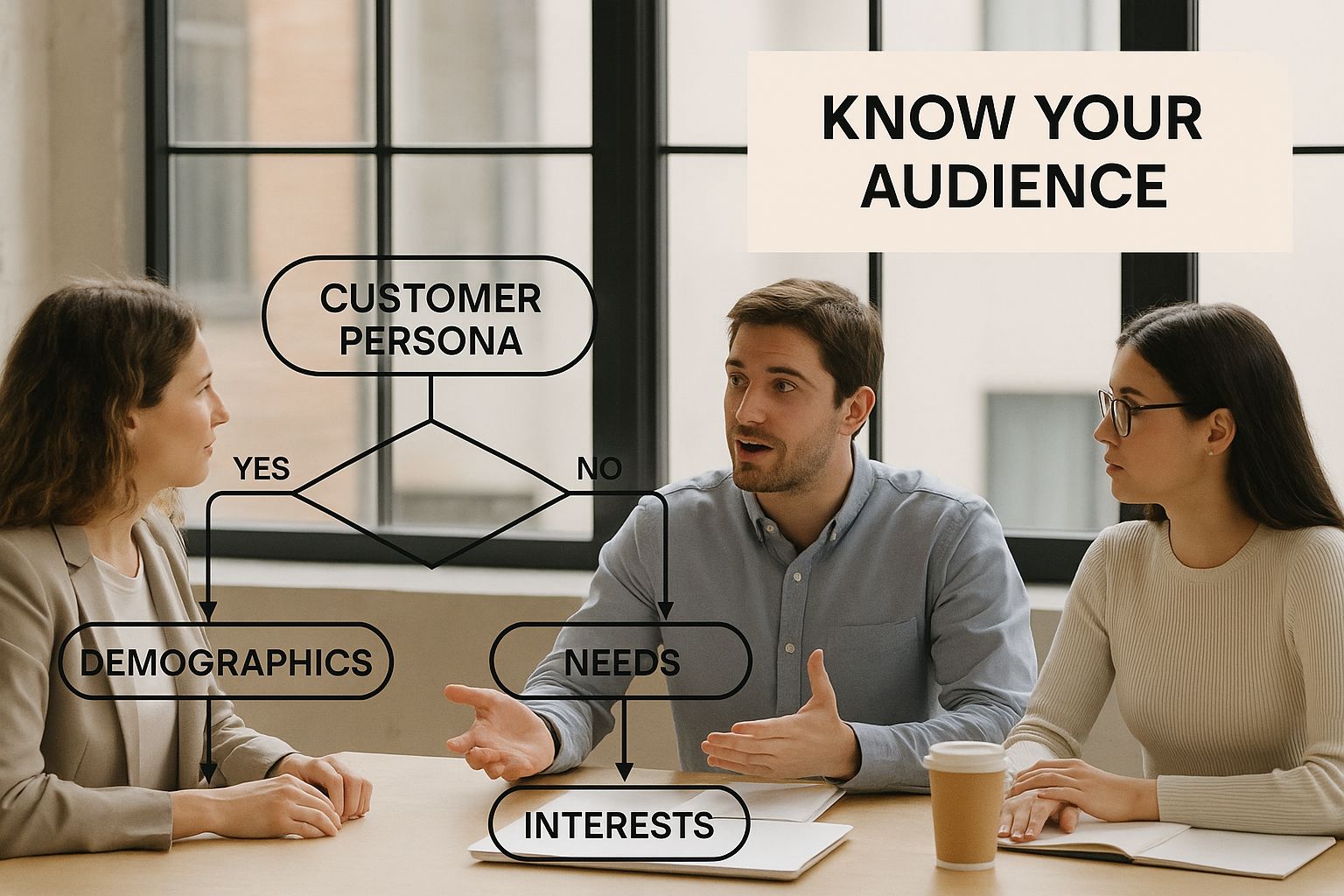
As you can see, every decision flows from a crystal-clear understanding of who you're trying to reach. Without that, you're just guessing.
Aligning Platforms With Your Business Reality
Okay, so you've figured out where your audience is. The next step is a hard, honest look in the mirror. It's not about what you want to do; it’s about what you can realistically do, and do well, day in and day out. Don't commit to a daily video series if you don’t have the gear, the time, or frankly, the interest.
When you're weighing your options, think about these three things:
- Resource Intensity: Does this platform demand slick video production like YouTube or TikTok? Or can you make a real impact with great writing and solid images, like on a blog or LinkedIn?
- Time Commitment: How much hands-on time does it take? A community-heavy platform might need daily check-ins, whereas a weekly blog post is a different kind of commitment.
- Skill Alignment: What is your team actually good at? If you have a killer writer, a blog or an email newsletter is a no-brainer.
The digital world is massive, but the data points to where people are spending their time. The average social media user now spends 145 minutes on these platforms every day, which is why over 90% of brands are right there with them. The giants are still Facebook (3.065 billion users), YouTube (2.5 billion), and Instagram (2 billion). They're powerful, but also incredibly noisy. For a deeper look at the numbers, you can explore more small business marketing statistics.
To help you decide, here's a quick matrix to map out your best-fit platforms based on your goals and resources.
Content Platform Selection Matrix for Small Businesses
This table helps you evaluate which content platforms are the best fit for your business based on your primary goals and target audience.
| Platform | Best For (Goal) | Primary Audience | Required Resources |
|---|---|---|---|
| Blog (on your website) | Building SEO authority, educating customers, lead generation | Users actively searching for solutions or information. | Strong writing skills, keyword research, time for deep-dives |
| Building brand personality, showcasing products, community engagement | Visually-driven consumers, younger demographics (Millennials/Gen Z). | High-quality photos/videos, graphic design, daily engagement | |
| B2B lead generation, establishing professional credibility, networking | Professionals, business owners, B2B decision-makers. | Professional writing, industry insights, consistent networking | |
| Email Newsletter | Nurturing leads, driving repeat business, direct communication | Existing customers and warm leads who have opted in. | Good writing, a solid email platform, consistent schedule |
| YouTube | Tutorials, product demos, building a loyal following | Viewers who prefer video content for learning and entertainment. | Video production skills, camera/audio equipment, editing software |
| TikTok | Brand awareness, reaching younger audiences, viral potential | Primarily Gen Z and younger millennials. | Creativity, short-form video skills, understanding of trends |
This isn't an exhaustive list, but it covers the core channels most small businesses should be considering. Use it as a starting point to narrow down your focus to just one or two platforms where you can truly make an impact.
Choosing Your Core Content Formats
The channels you pick will heavily guide your content formats, but you still have a lot of creative freedom. How does your audience like to learn? What's the best way to package your expertise?
A smart content strategy for a small business often hinges on one or two "pillar" formats that you can then slice and dice for other uses.
Think of your "pillar" content as your workhorse. A single, well-researched blog post can be splintered into a dozen social media updates, a script for a short video, and a key segment in your weekly email newsletter.
Here are some of the most effective formats and what they’re best for:
- Blog Posts: The undisputed champion of SEO. They’re perfect for showing what you know, answering customer questions, and building a foundation for long-term organic traffic.
- Video: Incredibly engaging. Use it for tutorials, behind-the-scenes glimpses, and customer success stories. Platforms like YouTube and Instagram Reels are the main players here.
- Email Newsletters: Nothing beats email for building a direct line to your audience and nurturing leads. If you're looking for a tool to manage this, check out our review of the Beehiiv newsletter platform to see if it’s a good fit.
- Case Studies: These are trust-building machines. They show real-world proof that you deliver results, which is absolute gold for any service-based business.
My advice? Start with one primary format on one primary channel. Get really good at it. Once you've got a system down and are seeing results, then—and only then—should you think about adding another layer. This focused approach is your best defense against burnout.
Crafting Content That Actually Connects and Converts
Alright, you've got your goals locked down and you know where you're going to post. Now for the fun part: creating content that actually does something. It can't just look pretty—it needs to grab your audience, pull them in, and get them to act.
This is where small businesses have a huge advantage over the big guys. You don't need a Hollywood-sized budget. What you need is to be real and relentlessly focused on solving your customer's problems.
Forget just listing features and benefits. That's what everyone else does. Instead, tell a story. Why did you start this business? Who have you helped? What happens behind the scenes? This is the stuff that makes people trust you. It’s how you turn a random visitor into someone who genuinely cares about your brand.
Weaving in Keywords Naturally
If you want people to find your amazing content, you have to think about SEO, and that means keywords. These are simply the words and phrases your ideal customers are punching into Google right now. The trick is to weave them into your writing so it sounds completely natural, not like a robot stuffed them in.
Think about it this way: a local bakery wouldn't just plaster "best cupcakes in Brooklyn" everywhere. That's clunky. Instead, they’d write a blog post titled something like, "Our Secret to Baking Moist Red Velvet Cupcakes in Brooklyn." It uses the phrase naturally while giving people something they actually want to read.
Here's how to approach it:
- Long-tail keywords are your secret weapon. Don't waste your time trying to rank for a super broad term like "marketing." You'll never beat the giants. Go for something specific like "content marketing ideas for local retailers." The search volume is lower, but the person searching for it is exactly who you want to talk to.
- Just answer their questions. Seriously, what do your customers ask you all the time? Turn those questions and your answers into blog posts, videos, or social media updates. It's an incredibly powerful way to use keywords and show you're the expert they've been looking for.
Writing Headlines and Calls to Action That Work
You could write the most insightful, life-changing article ever written, but if your headline is boring, nobody will read it. Your headline has one job: make a promise so good that people have to click. It needs to be clear, specific, and hit on a real pain point or desire.
Then, after they've read your masterpiece, what's next? You have to tell them! This is your call-to-action (CTA). A lazy "click here" is a total waste. You have to be specific and highlight the benefit.
Pro Tip: Make your CTA the next logical step in their journey. If they just finished an article about choosing the right website builder, a perfect CTA would be to "Explore our in-depth guide on the best website builder for blogs." It's helpful, not pushy like an abrupt "Buy now!"
A powerful CTA doesn't just ask, it guides. Instead of "Contact Us," try "Get a Free Quote in 24 Hours." See the difference? One is a vague request, the other sets a clear expectation and offers an immediate benefit. With marketing leaders planning to bump their content budgets by 45%, the pressure is on to get results. A sharp CTA is no longer optional—it's essential for getting a return on that investment. You can see more about the growing investment in content marketing and why this matters.
Building a Content Workflow That Actually Works
A brilliant content strategy is just a document until you put it into action. This is where the rubber meets the road, and honestly, it's where most small businesses get stuck. The initial excitement wears off, and the day-to-day grind of running the business pushes content to the back burner.
The secret isn't just to work harder; it's to build a realistic, sustainable workflow that fits your business, not the other way around.

This operational part of your content strategy for a small business is what turns good intentions into a growth machine. It’s all about creating a process that’s repeatable, prevents burnout, and keeps you from scrambling for ideas at the last minute.
Get Your Content Calendar in Order
You don't need a complex, expensive project management suite. Your most powerful weapon against inconsistency is a simple content calendar. Think of it as your command center—it tells you exactly what to publish, where, and when.
This can be as simple as a Google Sheet or a Trello board. If you want something a bit more organized, tools like Notion are fantastic because you can build a custom dashboard that tracks everything from a rough idea to a published post.
At a bare minimum, your calendar needs these columns:
- Publish Date: The day it all goes live.
- Topic/Headline: The core idea or working title.
- Content Format: Is it a blog post, an Instagram Reel, a newsletter?
- Channel: Where are you posting it? (e.g., Website blog, LinkedIn, TikTok).
- Status: A simple way to track progress, like Idea, Drafting, Review, and Published.
A well-managed calendar shifts content creation from a chaotic, reactive mess into a calm, proactive process. It gets rid of that daily "Oh no, what do I post?" panic.
Don't Create, Repurpose
Let's be real: as a small business owner, you don't have time to create brand-new, amazing content from scratch every single day. That’s a recipe for burnout. The solution is to work smarter, and that means embracing the art of repurposing.
The idea is straightforward: take one core piece of content and slice it and dice it into smaller assets for different platforms. This move multiplies the value of your initial effort and gives your best ideas a much longer shelf life.
For example, one in-depth blog post can easily be transformed into:
- A 10-part Twitter thread with the main takeaways.
- A script for a 60-second TikTok video.
- A shareable infographic for Pinterest or Instagram.
- The main feature in your weekly email newsletter.
- A slide deck for a detailed LinkedIn post.
If you really want to master this, digging into effective content repurposing strategies is a game-changer. It’s how you stay visible and consistent across all your channels without tripling your workload.
Measuring Your Content Success and Optimizing for Growth
If you're putting time and money into creating content but not measuring what it does for your business, you're essentially flying blind. You have to know if your hard work is actually paying off. This isn't about chasing feel-good numbers like social media 'likes'; it's about drawing a straight line from a blog post or video to a tangible business result.

A solid content strategy for a small business is built on a constant cycle of feedback. You publish, you analyze what people responded to, what led to a sale, and what completely missed the mark. This is how you stop wasting resources on tactics that go nowhere and instead, pour your energy into the things that genuinely grow your company.
Identifying KPIs That Actually Matter
First things first, you have to cut through the clutter and focus on Key Performance Indicators (KPIs) that mean something. A spike in likes is nice, but it doesn't keep the lights on. Your focus needs to be squarely on metrics that reveal how your content is actually guiding customer decisions and adding to your revenue.
For a small business, this is what you should be watching:
- Website Traffic: Are people showing up? Track your page views and unique visitors in a tool like Google Analytics to see if your content is successfully pulling people to your site.
- Conversion Rate: Of those visitors, how many are taking the next step? A conversion could be anything from a newsletter signup to a "request a quote" form submission. This tells you if your content is persuasive.
- Lead Quality: Are the leads you're getting from your content actually good prospects? This one's a bit more subjective, but it's crucial for making sure your sales efforts aren't wasted on tire-kickers.
- Time on Page: How long are people sticking around to read? A higher average time on page is a strong signal that your content is engaging and providing real value.
Let's be clear: your goal isn't just to get clicks; it's to get the right clicks. One blog post that brings in 1,000 readers who perfectly match your ideal customer is infinitely more valuable than a post that gets 10,000 random visitors who leave after five seconds.
To help you get started, here’s a quick-glance table of the metrics I find most valuable for small businesses, what they actually tell you, and the tools you can use to track them.
Key Content Marketing KPIs for Small Businesses
| Metric | What It Measures | Why It's Important | Tool to Use |
|---|---|---|---|
| Organic Traffic | Visitors who find your site through search engines like Google. | Shows the effectiveness of your SEO efforts and content relevance. | Google Analytics, Ahrefs |
| Conversion Rate | The percentage of visitors who complete a desired action. | Directly links content to business goals like lead generation. | Google Analytics (Goals), CRM |
| Time on Page | The average time visitors spend on a specific page. | Indicates content engagement and quality. Low time suggests a mismatch. | Google Analytics |
| Bounce Rate | The percentage of visitors who leave after viewing only one page. | High bounce rates can signal poor content or user experience. | Google Analytics |
| New vs. Returning Users | The ratio of first-time visitors to those who have visited before. | Helps gauge audience loyalty and the reach of your content. | Google Analytics |
| Keyword Rankings | Your website's position in search results for target keywords. | A direct measure of SEO success and content authority. | Semrush, Ahrefs, Google Search Console |
Tracking these KPIs consistently is the first step. The real magic happens when you use this information to make smarter decisions.
Creating Your Optimization Loop
Having the data is one thing; using it to improve is another. The real growth comes from setting aside time to review this data and letting it inform your next move. This doesn't have to be some monumental task. Just block out an hour or two each month to look at what’s working and what isn't.
Go through your top-performing content and ask yourself a few questions:
- Which topics drove the most traffic? This is your audience telling you exactly what problems they want you to solve.
- What formats are converting best? Maybe your audience loves video tutorials but ignores long-form articles. This tells you how they prefer to receive information.
- Can you spot any patterns in your most popular pieces? Perhaps they all feature customer stories, use a conversational tone, or offer a helpful checklist.
This simple analysis creates a powerful feedback loop. The insights you gain from your best content become the blueprint for your future work, making your strategy sharper and more effective with every piece you publish. That's how you build a content engine that delivers a real, sustainable return.
Common Content Strategy Questions From Small Businesses
https://www.youtube.com/embed/yZvFH7B6gKI
Even the best-laid plans come with questions. When you're building a content strategy from the ground up, it's completely normal to hit a few roadblocks or wonder if you're on the right track.
Let's walk through some of the most common questions I hear from small business owners. Getting these cleared up will help you move forward with confidence.
How Much Should a Small Business Budget for Content?
This is the million-dollar question, isn't it? While there’s no single right answer, a good starting point is to set aside 5-15% of your overall marketing budget specifically for content.
If you're brand new to this, my advice is to start lean. Don't try to be everywhere at once. Instead, pick one or two channels where you know your ideal customers hang out and focus on doing a great job there.
The most important thing is to track your return on investment (ROI). Once you see what's working and generating results, you can feel confident putting more money behind it. It's always better to scale up smartly than to blow a huge budget from day one.
How Long Does Content Marketing Take to Show Results?
I'll be honest with you—content marketing is a marathon, not a sprint. You might get some nice, early spikes in website traffic or social media engagement, but the real, game-changing results usually take 6 to 12 months of consistent effort.
Think of it like planting a garden. The work you do today—writing that helpful blog post, recording that insightful video—is what builds your authority and SEO strength over time. It won't bear fruit overnight, but it will continue to grow and attract customers long after you've published it.
This is the true power of content. Unlike a paid ad that vanishes the second you stop paying, your content library becomes a permanent asset, working 24/7 to bring people to your business.
Is It Better to Focus on Quality or Quantity?
Quality, hands down. Every single time.
One deeply researched, genuinely helpful article that solves a real problem for your customer is worth more than ten fluffy, generic blog posts. The goal isn't just to publish; it's to become the go-to resource on a topic for your audience.
This is how you build trust and establish yourself as an expert. Publishing less often but making sure every piece is outstanding will get you much further in the long run. High-quality content is also what gets shared, linked to, and ranked by search engines.
Can I Do This Myself or Do I Need to Hire Help?
Many small business owners handle their own content strategy perfectly well, especially at the start. After all, nobody understands your business and your customers better than you do. Your personal expertise is your greatest asset.
But as your business grows, your time will become your most precious commodity. When you find yourself stretched too thin, that's the time to think about getting some help.
You could start by outsourcing specific tasks, like hiring a freelance writer for blog posts or a designer for graphics. Or you might eventually partner with an agency to manage the whole thing. It all comes down to your budget, your skills, and what you can realistically commit to. If you're still building your online foundation, our guide on choosing the right website builder for a small business can help you get started.