What is Jamstack? A Simple Guide to Faster Websites
Wondering what is Jamstack? Discover how Jamstack improves web performance and security in this concise, easy-to-understand guide.

Let's get straight to the point. Jamstack isn't a programming language or a specific tool. Instead, it's a modern way of thinking about how we build websites and apps. It’s an architectural philosophy.
Imagine a classic restaurant where the chef cooks every single order from scratch. It works, but when things get busy, the kitchen gets backed up and customers have to wait. Now, think of Jamstack as an elite meal-prep service. All the complicated cooking is done ahead of time, so when an order comes in, a perfectly prepared meal is delivered in an instant. That's the core difference.
Unpacking the Jamstack Philosophy
At its heart, Jamstack flips the old web development model on its head. Traditional websites rely on a server to dynamically build a page every single time someone visits. This involves database queries and server-side processing, which takes time.
The Jamstack approach pre-builds everything upfront during a build step. The result is a collection of static HTML, CSS, and JavaScript files that are ready to go. These files are then distributed across a global Content Delivery Network (CDN), placing them physically closer to your users, no matter where they are in the world.
This seemingly simple shift has a massive domino effect on performance, security, and scalability. Since the pages are already built, they load at blistering speeds.
It’s an approach that's rapidly gaining ground. Back in 2019, Jamstack sites made up just 0.38% of all websites. By 2022, that number jumped to 2.7%—a clear indicator that developers are moving away from legacy platforms in favor of this faster, more secure architecture.
To give you a clearer picture, here's a quick breakdown of Jamstack's foundational ideas.
Jamstack at a Glance
| Concept | Brief Explanation |
|---|---|
| Pre-rendering | Pages are built into static files at deploy time, not on-demand for each visitor. |
| Decoupled Architecture | The front-end (what users see) is separate from the back-end (content and data). |
| APIs for Dynamics | Any server-side function is handled by reusable APIs, not a monolithic back-end. |
| Served from CDN | Static files are distributed globally, ensuring fast load times for everyone. |
This table captures the essence of the Jamstack model: build ahead, separate concerns, and serve globally for maximum efficiency.
Moving Beyond the Monolith
A core tenet of Jamstack is "decoupling." In traditional systems like a standard WordPress setup, the front-end (the theme) and the back-end (the content database and admin panel) are deeply intertwined. This "monolithic" structure can be rigid and difficult to manage.
Jamstack breaks that connection. This is often accomplished by using a headless CMS, a system that manages content but doesn't care how or where it's displayed. The content is simply made available through an API. This gives developers the freedom to choose any front-end technology they want, while content creators can work in a familiar environment.
The core idea is simple: pre-render as much as possible, serve it globally, and use APIs for any dynamic functionality. This creates a more resilient, performant, and secure web experience for everyone.
This philosophy directly addresses some of the biggest headaches associated with traditional web stacks:
- Superior Performance: Serving static files from a CDN is just fundamentally faster than making a server build a page from scratch for every single visitor.
- Enhanced Security: By removing the direct connection to a database or server-side code during a user's visit, you drastically shrink the potential attack surface.
- Greater Scalability: CDNs are built to handle huge traffic spikes without breaking a sweat, ensuring your site stays fast and online when you need it most.
By focusing on these principles, Jamstack provides a solid foundation for building the next generation of web experiences. If you're exploring this path, we have a complete guide to finding the right headless CMS to power your project.
The Three Pillars: JavaScript, APIs, and Markup

The name "Jamstack" does more than just sound modern—it's a direct nod to its core technologies: JavaScript, APIs, and Markup. To really get why this architecture is so fast and secure, you have to understand how these three parts work together. They’re not a monolithic block; they’re a decoupled system where each piece has a very specific and powerful job.
I like to think of it as building with high-tech LEGOs. Every piece is independent and specialized. But when you snap them together, the result is something far more flexible and resilient than a single, molded piece of plastic.
Let's pull apart each of these pillars to see what makes the whole structure so effective.
JavaScript: The Engine of Interactivity
On a Jamstack site, JavaScript is the workhorse handling all the dynamic features and user interactions, and it does this right inside the user's web browser. Once the pre-built HTML and CSS files load, JavaScript wakes up and brings the page to life, creating the kind of smooth, app-like experience everyone expects today.
This could be anything from fetching live data for a dashboard, managing a shopping cart, or handling a user login. Because these tasks don’t need to constantly ping a server for instructions, the entire site feels incredibly snappy and responsive.
The real magic here is that all the dynamic heavy lifting happens on the client side. This takes the load off the server, slashes latency, and makes the whole experience feel instantaneous to the user.
By executing logic in the browser, JavaScript lets a static site act like a full-blown dynamic application. You get the raw speed of static files with all the power of dynamic functionality.
APIs: The Connective Tissue
If JavaScript is the engine, then Application Programming Interfaces (APIs) are the fuel lines. They are the essential bridges connecting your front-end to all the back-end services it needs to function. This is where the decoupled nature of Jamstack really starts to pay off.
Instead of being locked into a single, all-in-one back-end, a Jamstack site can tap into an entire ecosystem of specialized services through APIs. This creates a nimble and scalable microservices architecture.
Here are a few common ways APIs are used in Jamstack projects:
- Headless CMS: Content for blog posts or product pages is pulled from services like Contentful or Strapi.
- E-commerce: Platforms like Shopify are integrated to handle products, inventory, and checkouts.
- Authentication: Services like Auth0 are used to manage user logins and secure protected content.
- Forms: Tools like Netlify Forms or Formspree capture user submissions without needing a custom server-side script.
This modularity means you can easily swap services in and out as your needs change, without having to tear down and rebuild the entire application.
Markup: The Pre-Built Foundation
The final pillar, Markup, is where Jamstack makes its most significant departure from traditional web development. With this approach, your entire website is pre-built into static HTML files during a "build step" that happens before any visitor ever arrives.
This process is usually handled by a Static Site Generator (SSG). These tools take all your source files—like Markdown for content and templates for layout—pull in any necessary data from APIs, and compile everything into a folder of plain, optimized HTML, CSS, and JavaScript. The architecture’s focus on pre-built Markup and client-side JavaScript is a core tenet of modern front-end development principles and a world away from old-school server-rendered apps.
Some of the most popular SSGs today include:
- Next.js: A very popular React framework prized for its flexibility and performance.
- Gatsby: Another generator built on React, fantastic for data-heavy, content-rich websites.
- Hugo: Written in the Go programming language, it’s famous for its absolutely blistering build speeds. You can get a great overview of tools like Hugo to see how they fit into a modern workflow.
After the build, these static files are deployed globally on a Content Delivery Network (CDN). When a user visits your site, the CDN serves the pre-built HTML file from a server physically closest to them, making load times nearly instant. There's no database to query or page to generate on the fly—and that’s the secret behind Jamstack’s incredible speed.
How Jamstack Differs From Traditional Architectures
To really get what Jamstack is, you first have to understand what it isn't. The magic of this approach truly clicks when you set it against the traditional, monolithic architectures that have powered the web for decades—think the classic LAMP stack (Linux, Apache, MySQL, PHP) behind platforms like WordPress. The difference isn't just a technical footnote; it’s a complete rethinking of how we build, deliver, and secure websites.
Let's try an analogy. A traditional website is like building a custom house on-site from the ground up. Every time a visitor knocks on the door, a team of builders (the server) has to scramble to assemble the entire structure (the web page) using raw materials (database content and templates). This happens over and over for every single visitor. It's slow, resource-intensive, and requires a constant security detail on-site.
Jamstack, on the other hand, is like a modern modular home. All the components are precision-built in a controlled factory setting (the build process). Then, they’re shipped and rapidly assembled on location (deployed to a CDN). The final product is delivered to the visitor fully formed. This pre-built model is the secret behind Jamstack’s massive gains in performance and security.
The Old Way: Monolithic Server-Side Rendering
In a traditional setup, the front-end (what you see in the browser) and the back-end (the server, database, and admin panel) are all tangled together in one big, tightly-coupled unit. When you request a page, it kicks off a whole chain reaction on the server.
- The server gets the request.
- It has to query a database to find the right content.
- It then runs that data through server-side code (like PHP).
- Finally, after all that work, it generates an HTML document and sends it back to your browser.
This entire process is full of potential bottlenecks. If the server is having a slow day or a database query gets complicated, the user is just left waiting. This architecture also leaves a huge attack surface wide open, since the live server and database are directly involved in handling every single request.
The New Way: Decoupled Pre-Rendering
Jamstack completely decouples this process. Instead of building pages on demand, it pre-builds everything into simple, static HTML files during a deployment step. These flat files are then distributed across a global Content Delivery Network (CDN), which has servers strategically placed all over the world.
Now, when a user requests a page, the CDN simply grabs the already-built HTML file from the server closest to them and sends it instantly. No real-time server-side rendering, no database queries. This radically simplified delivery pipeline is what makes Jamstack sites so incredibly fast and reliable. For a deeper look at this separation, it’s worth exploring the detailed comparison between Headless CMS and Traditional CMS, which shows how content management itself has evolved to fit this model.
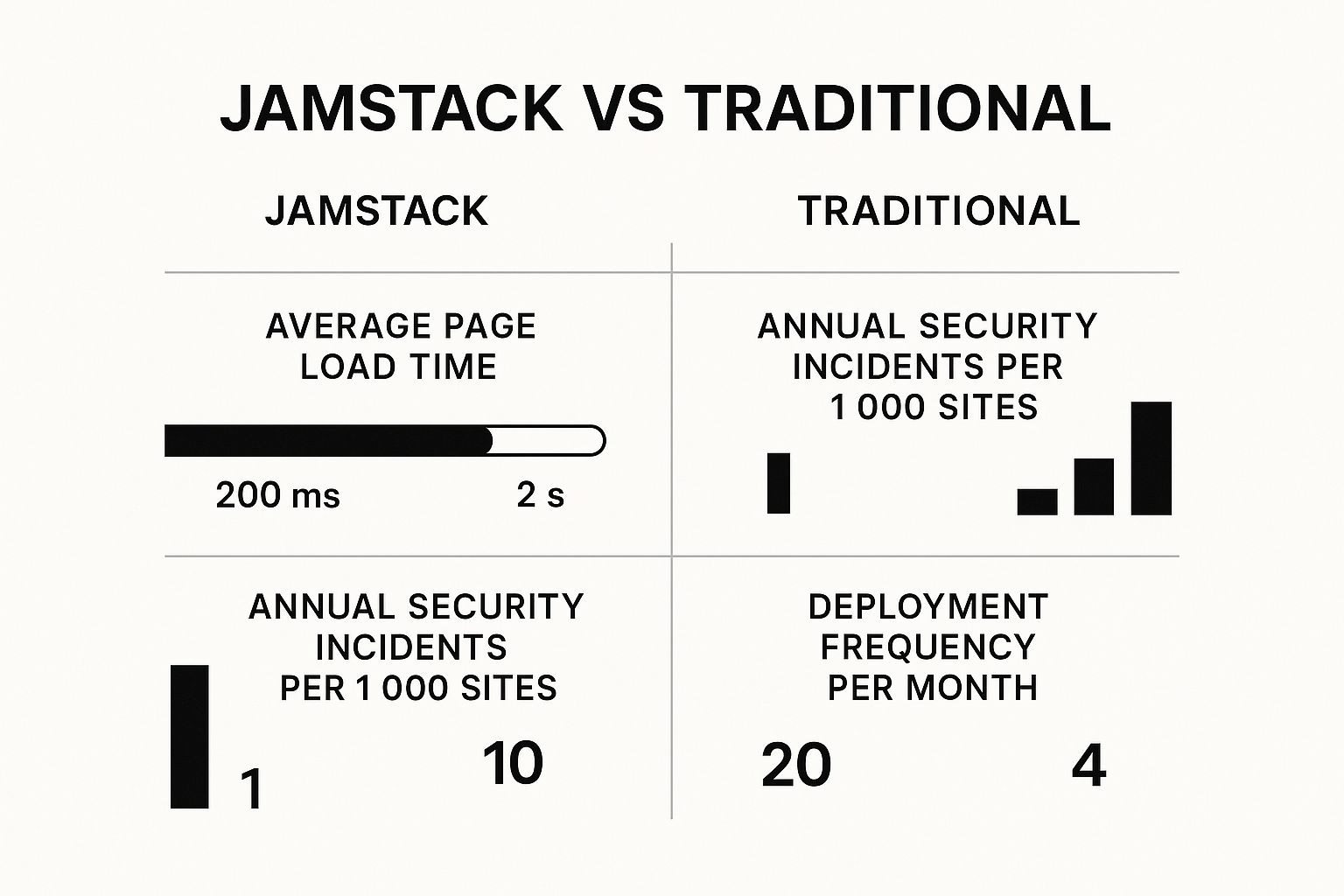
The data here really drives the point home. Jamstack sites consistently load faster, face fewer security headaches, and make it easier for teams to push updates more frequently.
Jamstack vs Traditional Monolithic Architecture
The fundamental shift becomes crystal clear when you put the two approaches side-by-side. The decision here impacts everything from the user's experience to your development workflow and even your hosting bills.
| Attribute | Jamstack Architecture | Traditional Architecture (e.g., WordPress) |
|---|---|---|
| Page Generation | Pre-built during deployment into static files. | Generated on-the-fly by the server for each request. |
| Hosting | Static files served globally from a CDN. | Dynamic hosting on a specific server or cluster. |
| Performance | Extremely fast; no server-side processing at request time. | Slower; dependent on server and database performance. |
| Security | Minimal attack surface; no direct server/database access. | Large attack surface; server and database are live targets. |
| Scalability | Scales automatically with the CDN. | Requires complex server configuration and load balancing. |
| Backend Coupling | Decoupled; front-end is separate from back-end services. | Tightly coupled; front-end and back-end are one unit. |
| Developer Tools | Modern tools, Git-based workflows, choice of frameworks. | Often limited to the platform's ecosystem (e.g., PHP). |
This table shows that while both can deliver a website, they do so in fundamentally different ways, with Jamstack prioritizing a pre-built, decoupled, and globally distributed model for superior results. For teams adopting a content-first strategy, checking out a list of open source headless CMS options can highlight just how flexible this new approach can be.
The core differences really boil down to a few key areas:
- Performance: Jamstack sites are just plain faster. Serving pre-built static files from a CDN eliminates the server-side processing lag that plagues traditional sites relying on database queries for every page load.
- Security: By severing the direct link between the user and the live database/server, Jamstack dramatically shrinks the attack surface. Monolithic systems, in contrast, expose their core infrastructure with every single request, creating more vulnerabilities.
- Scalability: A Jamstack site scales almost effortlessly. CDNs are engineered to handle enormous traffic spikes without breaking a sweat. Scaling a traditional site often means a frantic, expensive scramble to add more server power.
- Developer Experience: Developers love Jamstack because they get to use modern tools, Git-based workflows, and a universe of APIs. This freedom often leads to much faster and more enjoyable development cycles compared to being locked into the constraints of an older, monolithic system.
Why Bother With Jamstack? The Real-World Benefits
https://www.youtube.com/embed/ySJGjo3_EX4
Okay, so we've covered the what and the how. But the real question is why? Why are so many developers and businesses ditching their traditional setups for Jamstack? The answer isn't just about chasing the latest trend. It's about a handful of powerful, interconnected benefits that solve some of the oldest and most frustrating problems in web development.
These aren't just minor technical improvements, either. They lead to real business results: happier users, lower bills, and a much more secure online presence.
Seriously Fast Performance
First and foremost, Jamstack sites are incredibly fast. We’re talking near-instant load times. This is possible because Jamstack sites are served as pre-built, static files directly from a Content Delivery Network (CDN). Think of a CDN as a global network of servers, and when a user visits your site, the content is delivered from the server physically closest to them.
This completely cuts out the slow, clunky server-side processing that bogs down traditional sites. There's no waiting for a server to build the page on the fly; it's already built and waiting.
This speed isn't just a nice-to-have. It’s a make-or-break metric. Studies have shown that 53% of users will leave a website if it takes more than three seconds to load. By serving pages almost instantly, Jamstack helps you keep those users on your site. This boost in performance also gets a nod from search engines, often leading to better SEO rankings and more traffic. Just look at Smashing Magazine, which saw a 50% boost in traffic after they made the switch. You can dig deeper into how Jamstack performance drives business results.
Superior Security by Design
Another huge win for Jamstack is its built-in security. With a traditional setup like WordPress, you have a lot of moving parts—the database, server-side code, and countless plugins—all interacting with every single user request. This creates a massive surface area for potential attacks.
Jamstack slashes this risk by its very nature. The live site is just a collection of static files. There’s no direct connection to a database, no server-side code to execute, and no complex plugin ecosystem to keep patched. Any dynamic features are handled by isolated, third-party APIs.
By separating the front-end from the back-end systems, Jamstack essentially takes the server out of the line of fire during a user's visit. Shrinking the attack surface this dramatically is one of its most compelling security features.
This architecture makes it much, much harder for bad actors to find a way in, giving everyone from the developer to the business owner some much-needed peace of mind.
Effortless Scalability and Lower Costs
Ever had a blog post go viral and crash your server? That’s a classic problem for traditional sites. Handling a sudden spike in traffic usually means frantically trying to scale up expensive servers and complex load balancers.
Jamstack handles this situation with total grace. CDNs are designed from the ground up to serve massive amounts of traffic all over the world. When your site suddenly gets popular, the CDN just... works. It serves the same static files to ten thousand people as easily as it does to ten. Your site stays fast and online, no sweat.
This efficiency translates directly into cost savings:
- Cheaper Hosting: Serving simple static files is a world away from the cost of running and maintaining dynamic application servers.
- Less Maintenance: With fewer moving parts and a tiny attack surface, you’ll spend far less time and money on server patches and security updates.
- Simpler Infrastructure: You can often say goodbye to complex server clusters and database management, which cuts costs even further.
An Improved Developer Experience
Last but not least, developers genuinely love working with Jamstack. Decoupling the front-end from the back-end frees them to use the modern tools they prefer, like React, Vue, or Svelte. The entire workflow is usually built around Git, which creates a clean, version-controlled history of every change and makes teamwork a breeze.
This modern approach, along with the freedom to pick the best static site CMS for the job, lets development teams build and ship much faster. The result is a more productive and enjoyable development cycle, empowering teams to release new features with more speed and confidence.
Where Jamstack Shines: Practical Use Cases

The theory behind Jamstack—blazing speed, tight security, and effortless scaling—isn't just talk. It translates into real, tangible advantages for all sorts of projects. This isn't just an architecture for hobby blogs; it’s the engine behind complex, high-traffic sites for some of the biggest names in tech, retail, and media.
Seeing Jamstack in the wild is the best way to understand its power. From global e-commerce stores to slick corporate marketing sites, its pre-built, decoupled approach provides a rock-solid foundation. It's the go-to choice when performance and reliability are absolutely non-negotiable.
High-Performance Marketing and Corporate Websites
For any marketing website, speed is the name of the game. A slow-loading landing page is the fastest way to lose a potential customer. Jamstack tackles this head-on by serving pre-rendered HTML files directly from a CDN, which means near-instant load times that both users and search engines love.
Corporate sites also get a massive security boost. By completely removing the live database and server-side code from the initial user request, you drastically shrink the attack surface. This creates a powerful defense against common web vulnerabilities, making it a smart, secure choice for companies that need to protect their brand.
The beauty of Jamstack is that it lets marketing teams move fast while developers maintain a secure, high-performance site. Content can be updated instantly through a headless CMS, which triggers a new build without ever touching the site's core structure or slowing it down.
This separation of duties is a game-changer. Marketers get a user-friendly interface to manage content, and developers are free to innovate on the front end without being shackled to a clunky, monolithic system.
Blazing-Fast E-Commerce Stores
In e-commerce, every millisecond can impact your bottom line. Slow product pages lead directly to abandoned carts and lost sales. Jamstack flips the script by pre-building product listings and category pages, ensuring they load in the blink of an eye for shoppers anywhere in the world.
So how does it handle dynamic features like shopping carts or payments? Through APIs. This creates a powerful hybrid experience that delivers the best of both worlds:
- Static Speed: Product pages and marketing content are delivered as fast static files.
- Dynamic Power: Shopping carts, user logins, and checkouts are handled by specialized microservices.
This model means an online store can handle huge traffic spikes during events like Black Friday without breaking a sweat. The CDN simply absorbs the load, guaranteeing a smooth and reliable shopping experience for every single customer.
The Expanding Future of Jamstack
The Jamstack ecosystem isn’t just sitting still; it's growing at a remarkable pace. This growth is fueled by its appeal to developers and businesses who are fed up with slow, insecure, and clunky websites. Industry analysts are projecting a compound annual growth rate (CAGR) somewhere between 18.7% and 20% for the Jamstack market through 2026. This isn't just a niche trend—32% of Jamstack developers already work in multi-million dollar businesses. You can read more about the future outlook for Jamstack development and where the market is heading.
This momentum is driven by two key trends: the maturation of headless CMS platforms and the rising power of serverless functions. Headless systems like Strapi are becoming incredibly polished and feature-rich, finally bridging the gap between developers and content teams. If you're curious, our guide on how to use Strapi is a great place to start. At the same time, serverless functions are making it easier than ever to add complex back-end logic without the headache of managing servers, pushing the boundaries of what a "static" site can do.
Answering Your Top Questions About Jamstack
Whenever a new way of building websites comes along, it’s natural for questions and a few myths to pop up. Jamstack is a different way of thinking, and it’s easy to get wires crossed on what it really is and what it’s for.
Let's clear the air. Here are some straightforward answers to the questions I hear most often from developers, marketers, and business owners trying to get a handle on Jamstack.
"Is Jamstack Just for Static Websites?"
This is probably the biggest misconception out there. The short answer? A loud and clear no.
While Jamstack leans heavily on pre-rendering pages into static files, that’s just about how the site is delivered to the user's browser—it has nothing to do with what the site can actually do. The "static" part is what makes it so mind-blowingly fast.
Once that initial static page loads in a flash, client-side JavaScript wakes up and takes the reins. This is where the magic happens. It can connect to any number of APIs to handle complex features like user logins, shopping carts, or even real-time data feeds. You get the rock-solid performance of a static site with all the dynamic power of a modern web app.
The core idea is simple: deliver a pre-built, static page for maximum speed. Then, let client-side JavaScript and APIs handle all the dynamic, interactive stuff.
It's truly the best of both worlds.
"Can I Even Use a CMS with Jamstack?"
Absolutely. In fact, pairing Jamstack with a headless Content Management System (CMS) is one of the most powerful combinations in modern web development. It’s a game-changer for content teams.
Unlike a traditional, monolithic CMS like WordPress where the content and the website's front-end are fused together, a headless CMS is different. It’s a pure, back-end-only content repository. It doesn't care what the website looks like; it just makes the content available through an API.
This setup is a perfect match for Jamstack. Here’s why:
- Total Flexibility: Your developers can build the front-end with whatever modern tools they love—like React or Vue—without being stuck inside a clunky CMS templating system.
- Tighter Security: Your content management system is completely separate from your public-facing website. This dramatically shrinks the attack surface for bad actors.
- Wicked-Fast Performance: The website pulls content during the build process to generate those fast-loading static pages, preserving the core speed benefit of Jamstack.
This means your marketing team gets a friendly interface to manage content, and they can publish updates by triggering a new site build—often without needing a developer to touch a single line of code.
"Is Jamstack Hard to Learn?"
It really depends on where you're starting from. If you’re a developer who is already solid with HTML, CSS, and especially JavaScript, the transition feels pretty natural. After all, the "JAM" in Jamstack stands for JavaScript, APIs, and Markup.
The real learning curve isn’t about code; it’s about a new way of thinking. You have to get comfortable with a workflow that revolves around a build process. Instead of a live server constantly building pages, you use tools called static site generators (like Next.js, Hugo, or Eleventy) to pre-build your site.
Understanding the Git-based workflow is also key. The whole process is usually automated: you push a change to a repository, and it automatically triggers a build and deploys the new version of your site. It might sound like a lot at first, but once you get the hang of it, it's a much cleaner and more reliable way to work.
"When Should I Not Use Jamstack?"
Look, Jamstack is a fantastic choice for the vast majority of projects, but it's not a silver bullet. There are a few edge cases where a traditional server-rendered approach might still make more sense.
One classic example is an application that needs constant, real-time data synced across tons of users at once. Think of something like a live stock trading platform or a collaborative editor like Google Docs, where every single change has to be reflected for everyone else instantly. You can do this with Jamstack using WebSockets and other tricks, but a server-centric model is often just more direct for these hyper-dynamic scenarios.
Another thing to watch for is build times on truly enormous sites—I'm talking millions of pages. A full rebuild could take a very long time, which might be a dealbreaker if you need to push content updates quickly. That said, this problem is already being solved by features like Incremental Static Regeneration (ISR) in modern frameworks, which can rebuild individual pages on demand without kicking off a full site build.