
How to Scale Content Marketing Without Losing Quality
Discover how to scale content marketing with proven frameworks and tools. Learn actionable strategies to grow your impact and drive measurable business results.


If you want to scale your content marketing, you can't just keep doing what you're doing, but more of it. You have to shift from a reactive, one-off approach to a predictable, system-driven engine. This all starts with building a solid foundation: a documented strategy, crystal-clear audience personas, and well-defined workflows.
The truth is, success isn't just about churning out more content; it’s about consistently producing the right content, efficiently.
Build Your Content Operations Foundation

Trying to scale content without a strong operational backbone is like building a skyscraper on a sand foundation. It’s only a matter of time before cracks appear, deadlines get blown, and quality takes a nosedive. The first real step toward sustainable growth is putting the systems in place to prevent that chaos before it even starts. This goes way beyond a simple content calendar—it's about creating a true operational framework.
Document Your Content Strategy
Think of your documented strategy as your North Star. It’s the single source of truth that ensures every blog post, every social media update, every video serves a specific, meaningful business objective. And it needs to be easily accessible to everyone who touches your content.
At a minimum, your strategy document should spell out:
- Business Goals: What are you actually trying to accomplish? Are you aiming to increase qualified leads by 15%? Or maybe boost organic traffic by 30%? Get specific.
- Content Pillars: These are the core topics and themes your brand owns. They should sit at the intersection of your expertise and your audience's biggest needs.
- Audience Personas: Go deep on who you're talking to. What are their pain points, their motivations, their goals? Where do they hang out online?
- Success Metrics: Define your Key Performance Indicators (KPIs) upfront. You need to know how you'll measure success, whether it's conversion rates, engagement, or SEO rankings.
Define Your Content Workflow and Structure
With your strategy locked in, it's time to map out the production process. A well-defined workflow eliminates the guesswork and creates a repeatable path from a raw idea to a published asset. It clearly defines who does what, and when, which is absolutely essential for preventing bottlenecks as you ramp up volume. This should cover every stage: ideation, outlining, drafting, editing, design, and final approval.
A crucial piece of this puzzle is a logical content hierarchy. A clear plan for how your content is organized and interlinked isn't just good for user experience—it's fundamental for SEO. Understanding the principles behind a strong site structure can dramatically impact your content's visibility.
The goal here is to build a system so solid that anyone on your team can follow it. This is what allows you to bring in new resources, like freelance writers or new software, without everything falling apart.
To really get moving, start looking into small business marketing automation to handle things like email distribution and social scheduling. This buys back your team’s time to focus on what humans do best: creating high-value, strategic content. For a deeper dive on this, you can learn more about what is information architecture from our detailed guide. This operational clarity is the bedrock of any successful scaling effort.
Building Your Content Production Engine

A great strategy is just a starting point. The real challenge—and where most operations falter—is in execution. To scale up, you need to stop creating content on a case-by-case basis and start building a repeatable, high-output system. Think of it as moving from a workshop to a factory floor.
This transition from ad-hoc creation to a well-oiled machine hinges on one thing: standardization. Without it, every new article or video becomes a brand-new project, and that’s a massive drain on time and resources.
Nail Down Your Briefs and Templates
A truly exceptional creative brief is the single source of truth for any project. It’s the document that stops ambiguity in its tracks and cuts down on the endless, productivity-killing back-and-forth between writers, designers, and managers.
A standardized brief should give a creator everything they need to get started. Don't leave anything to guesswork.
At a minimum, your brief must include:
- Target Persona: Who, exactly, are we talking to?
- Primary Keyword & SEO Goals: What's the search intent and what are our optimization targets?
- Key Message & Angle: What's the one core idea this piece needs to land?
- Call to Action (CTA): What do we want the reader to do when they're done?
Creating templates for your most common formats—blog posts, case studies, social media graphics—is another game-changer. It ensures everything looks and feels like it came from your brand and lets your team pour their creative energy into the actual message, not the setup.
Grow and Manage a High-Performing Content Team
Sooner or later, scaling means bringing more people on board, often specialized freelancers. The trick is to treat them as an integrated part of your team, not just disconnected contractors you send assignments to. This requires a solid process for finding, onboarding, and giving feedback to your talent.
- Vetting: Forget generalists. You want specialists with a proven track record in your specific niche. Always ask for work examples that align directly with your content pillars.
- Onboarding: Never just email a brief and hope for the best. A new contributor needs a proper onboarding kit with your brand style guide, detailed audience personas, and a few examples of your best-performing content so they know what "good" looks like.
- Feedback Loops: Use your project management tool to create a structured feedback process. Vague comments like "I don't like it" are useless. Tie specific, actionable feedback directly to the goals outlined in the original brief.
Scaling your team is critical, as content marketing is now a core business strategy for 82% of companies. Yet, with 54% of B2B marketing departments having just two to five people, getting efficient with your resources is non-negotiable. Dive into more content marketing statistics to see the full picture.
Create Total Transparency with a Master Content Calendar
Your central content calendar is the command center. Whether you use Asana, Trello, or Notion, this is where you create a single source of truth for all projects, deadlines, and responsibilities.
This calendar should map the entire content lifecycle, from the initial idea all the way through publication and promotion. Using a flexible tool is crucial here, especially as your operation grows. Many forward-thinking teams are also exploring different open-source headless CMS options to build a more adaptable tech stack that plugs right into these project management hubs.
Ultimately, this system gives everyone on the team clarity, prevents bottlenecks, and makes your entire production workflow predictable and reliable.
Trying to scale content with purely manual processes is a recipe for burnout. The more you produce, the more human effort you need, and you quickly hit a point of diminishing returns. This is where technology, especially AI, stops being a "nice to have" and becomes a critical part of your operation.
Think of it as a force multiplier. The right tech stack doesn't replace your talented people; it supercharges them. It automates the tedious, repetitive work, freeing up your team to pour their energy into what really matters: strategy, creativity, and high-level thinking.
Speeding Up Research and Optimization
A huge chunk of time is burned before anyone even starts writing. Keyword research, SERP analysis, digging into what competitors are doing—it all adds up. AI-driven platforms can compress this entire pre-production phase from days down to hours.
Tools like SurferSEO or Clearscope do the heavy lifting for you. They analyze what's already ranking and give you a data-backed blueprint for what to include, how to structure your piece, and which terms to hit. This takes the guesswork out of SEO and gives every article a much stronger foundation for organic success right out of the gate.
Smart technology streamlines the entire content lifecycle. Marketers report losing an average of 60 hours a year due to inefficient tools, with enterprise teams losing even more. Investing in an integrated stack directly translates to reclaimed productivity.
Using AI for Content Creation and Adaptation
Generative AI is no longer a gimmick; it's a legitimate creative partner. It's fantastic for blasting through writer's block and getting a first draft on the page, whether it's for a blog post, social media updates, or even video scripts.
The key is to treat it as an assistant, not the final author. The AI gets the basic structure down, and then a human editor steps in to add nuance, brand voice, and genuine insight. This hybrid approach lets one writer multiply their output without seeing quality dip. For example, by exploring the best AI video generator tools, you can automate a massive part of your video production workflow and seriously ramp up your output.
AI is also a game-changer for adapting assets. Have a killer design for one platform? AI can instantly resize and reformat it for every other channel, creating dozens of variations in minutes.
Creating a Central Hub for Your Content
As your content library explodes, just finding what you need becomes a job in itself. Without a system, assets get lost in email threads and forgotten folders. A robust Content Management System (CMS) and a Digital Asset Management (DAM) platform are non-negotiable for scaling.
Here's how they help:
- Content Management System (CMS): This is the command center for all published content. It makes organizing, updating, and optimizing your library a manageable task, even with thousands of assets.
- Digital Asset Management (DAM): Think of this as your official library for all creative files—images, videos, logos, and brand guides. It ensures consistency and stops people from using outdated or off-brand visuals.
To truly tie your operation together, a good technology stack is essential. Here’s a look at the core components you'll need.
Essential Tools for Your Content Scaling Stack
| Tool Category | Example Tools | Primary Scaling Function |
|---|---|---|
| Project & Content Hub | Notion, Asana, Monday.com | Centralizes briefs, calendars, and assets to create a single source of truth. |
| SEO & Research | Ahrefs, Semrush, SurferSEO | Automates keyword research, competitor analysis, and on-page optimization. |
| AI Writing Assistant | Jasper, Copy.ai, ChatGPT | Accelerates first drafts and helps overcome writer's block. |
| Design & Asset Creation | Canva, Adobe Express | Enables non-designers to create on-brand visuals quickly. |
| Digital Asset Mgmt. | Brandfolder, Bynder | Organizes and distributes all creative files from a central library. |
Building this foundation ensures your team has the operational scaffolding needed to support a high-volume content engine.
Platforms that blend project and knowledge management can be especially powerful. For instance, using Notion for project management can create that central hub where your entire content universe lives, from initial ideas to published pieces. A unified system is what makes finding, updating, and repurposing content not just possible, but efficient.
Multiply Your Impact with Content Repurposing
The constant grind of creating net-new content is a resource black hole. A much smarter way to scale your content operation is to get more mileage out of what you’ve already created. This means ditching the "one and done" mindset for good.
Instead, start treating every major piece of content as a wellspring of raw material for future assets. Rather than endlessly chasing the next big idea, take a hard look at your top-performing content. That comprehensive webinar or in-depth research report isn't just one asset—it's the foundation of an entire content ecosystem you can build out. This keeps your channels full without the constant burnout of facing a blank page.
The visual below maps out how you can use technology to speed this process up.
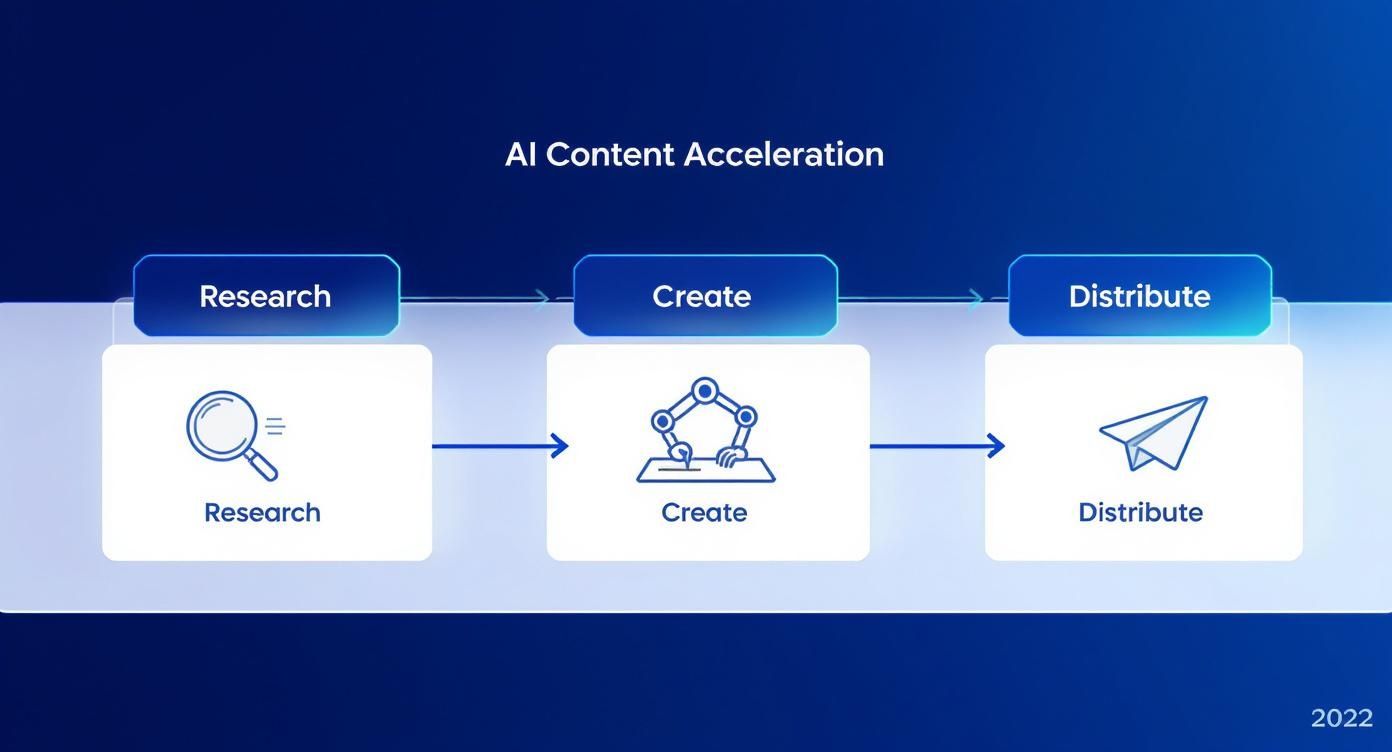
As you can see, the right tech stack can help you streamline everything from initial research to scaled distribution, which is the engine of an effective repurposing strategy.
Break Down Your Pillar Content
Your first move is to identify your pillar content. These are your big, beefy assets—the ones that comprehensively tackle a core topic for your audience. Once you've singled out a pillar piece, say a 2,000-word guide, the real fun begins. It's time to break it down.
Let's imagine you have one definitive guide on project management software. You could easily "atomize" it into a whole host of smaller assets:
- Five short blog posts: Each post drills down into a specific section or sub-topic from the original guide.
- Ten social media text posts: Pull out punchy statistics, surprising facts, or quick, actionable tips.
- An infographic: Create a visual that maps out the core workflow or key data points you discussed.
- A short video script: Turn one section into a snappy 60-second explainer for TikTok or Instagram Reels.
- A three-part email newsletter series: Give your subscribers the high-level takeaways delivered straight to their inbox.
This isn't just about filling the calendar; it's about meeting different segments of your audience on their preferred channels with content formatted specifically for that platform.
The real magic of repurposing is its sheer efficiency. When you create variations from a single, approved source asset, you can slash production time by up to 90%. That frees up your team to think strategically instead of just feeding the content beast.
Build a Repurposing Workflow
To make this sustainable, you need to bake it right into your content production process. Don't treat it as an afterthought. When you commission a new piece of pillar content, your creative brief should include a dedicated section for repurposing ideas. This forces everyone to think about multiplication from day one.
The more derivative assets you create, the more doors you open for your audience to find you. You're building an interconnected web of content that naturally boosts your SEO. All those smaller, specific pieces linking back to the foundational pillar content are a great way to increase blog traffic. By systematically repurposing, you're not just making more "stuff"—you're building a more resilient, far-reaching content program.
Using Data to Steer Your Scaled Content Strategy
When you start seriously ramping up content production, your gut feelings about what works just won't cut it anymore. Data has to become your North Star. It’s what transforms a high-volume content operation from a shot in the dark into a precision-guided growth machine.
Without a solid system for measuring what’s happening, you’re just adding to the noise. The real goal here is to move past surface-level vanity metrics and zero in on the numbers that actually connect to business results. This means building a repeatable process to track, analyze, and act on performance data so you know exactly what to create, update, or promote next.
Building Your Measurement Framework
First things first, you need a single source of truth for your content's performance. You can't be pulling numbers from ten different places and trying to stitch them together. Tools like Google Analytics 4, SEMrush, or HubSpot are great for this, letting you build a central dashboard that shows you the KPIs that truly matter.
Your dashboard should give you a clear view of the entire customer journey. Think about it in these stages:
- Top-of-Funnel (Awareness): Are we reaching new people? Look at organic traffic growth, new users, and changes in keyword rankings. This tells you if your content is doing its job of attracting a fresh audience.
- Mid-Funnel (Engagement): Is our content actually engaging? Keep an eye on metrics like time on page, scroll depth, and the click-through rates on your internal links. These numbers show if people are sticking around and digging deeper.
- Bottom-of-Funnel (Conversion): Is this content driving business? This is where the money is. Track goal completions, lead magnet downloads, and the specific conversion rates from your blog posts. This is the data that proves ROI to the higher-ups.
I’ve seen so many teams scale up and make the mistake of treating all data as equally important. It's not. An article with 1,000 views that brings in zero leads is a ghost town compared to a piece with 100 views that converts at 5%. Focus is everything.
Getting a complete view of the journey often means connecting your systems. It’s incredibly powerful when you can see exactly how a blog post leads to a new customer. You can learn more about the benefits of integrating your CMS and CRM platforms to get that full picture.
Running a Content Audit and Optimization Cycle
Let's be real: with a huge content library, not every piece is going to be a home run. That’s why a regular content audit isn’t just a "nice-to-have"—it's an absolute necessity for maintaining quality and performance as you scale. This is just a systematic review to figure out what's working, what's flopping, and where the low-hanging fruit is.
When you audit, you'll find your content generally falls into one of three buckets:
- High-Performers: These are your all-stars. The job here is to squeeze even more value out of them. Promote them again, turn them into videos or infographics, and make sure you’re sending plenty of internal links their way.
- Underperformers: This is the content that’s just sitting there, collecting dust with little to no traffic. These pieces are prime candidates for a major refresh, a complete rewrite, or maybe even being merged into a more successful article.
- Cannibalization Issues: This happens more than you'd think. You'll find two or three articles all competing for the exact same keywords, hurting each other's chances to rank. The fix is to consolidate them into a single, powerhouse piece of content.
This cycle of auditing and optimizing is what keeps your content library from becoming a sprawling, unmanageable mess. It ensures that as you grow, your content remains a powerful asset that drives real, tangible business results.
Unpacking the Common Questions Around Scaling Content Marketing
Growing your content operation is exciting, but it definitely brings up a lot of new questions. Once you start moving past a handful of posts a month and into a more serious production rhythm, you'll inevitably hit some new roadblocks. Let’s get straight to the point and tackle some of the most common hurdles I see teams face.
How Can I Possibly Keep Quality High While Pumping Out More Content?
This is the classic scaling dilemma, isn't it? The secret is to stop thinking like a creator and start thinking like a system builder. Quality can't be a happy accident; you have to design a workflow that produces it reliably.
Your Creative Brief is Everything: A truly detailed, non-negotiable creative brief is your first and best defense against off-brand or low-quality work. It ensures every single person touching the content—from your in-house strategist to a brand-new freelancer—is working from the same playbook.
Document Your Brand Voice: You need a living, breathing style guide. This isn't just about grammar; it should be packed with examples that clearly show what your brand sounds like. What’s on-brand? What’s off? Show, don't just tell.
Build a Review Gauntlet: One person can't be the quality gatekeeper forever; that's a recipe for burnout and a massive bottleneck. A much better approach is a multi-step review process. Maybe it's a peer review for factual accuracy, then an editor for flow and voice, and a final check by an SEO specialist before anything goes live.
Should I Hire In-House Staff or Just Bring on Freelancers?
Honestly, there's no magic bullet here. The most successful and resilient teams I’ve worked with almost always use a hybrid model. It gives you the best of both worlds: stability and flexibility.
Your in-house team should be the strategic core. They are the keepers of the flame—the ones who own the content strategy, manage the editorial calendar, and have the final say on what represents the brand. Think of them as the architects.
Freelancers, then, become your specialized builders. They are perfect for execution-heavy tasks where you need subject matter expertise or just raw production power. Need ten articles on a niche topic? A freelancer is perfect. Need a video script? Find a specialist. This lets you dial your production up or down without the heavy cost of a full-time hire.
The smartest teams I've seen don't treat freelancers like disposable ticket-takers. They treat their core freelance group like true partners, bringing them into Slack, giving them consistent feedback, and making sure they understand the bigger business goals.
Realistically, How Long Until We See Results from All This?
Let's be clear: scaling your content is a long game. It’s an investment in a powerful, sustainable marketing asset, not a switch you flip for instant leads.
While you might get some quick buzz from more social posts or a flurry of new blog articles, the real payoff—that meaningful, compounding growth in organic traffic and conversions—takes patience.
As a general rule of thumb, you should start seeing significant, measurable traction within 6 to 9 months. This gives your content enough time to get indexed, start earning links, and climb the search rankings for keywords that matter. The single most important factor is consistency. Trust the process and stick with it.