9 Content Management Best Practices for 2025
Master these 9 essential content management best practices for 2025. Learn to optimize strategy, workflows, and performance for maximum impact.


Content is the engine of growth, but managing it without a structured approach leads to inconsistency, wasted resources, and missed opportunities. The key to transforming this operational chaos into strategic clarity lies in adopting proven content management best practices. These principles provide a comprehensive framework that covers everything from initial strategy and organization to workflow optimization and performance analysis. By implementing a systematic process, teams can empower themselves to create, manage, and deliver high-impact content with greater efficiency and purpose.
This guide moves beyond generic advice to offer a detailed breakdown of nine critical practices that will elevate your content operations. We will explore actionable methods for documenting your content strategy, establishing robust version control, and implementing intelligent content taxonomies. You will learn how to build effective quality assurance workflows, manage the entire content lifecycle, and optimize distribution across multiple channels. Furthermore, we will cover the technical pillars of SEO-driven metadata, performance analytics, and essential security protocols. Adopting these content management best practices will ensure every asset you produce is purposeful, measurable, and drives tangible results for your organization. This is your blueprint for building a scalable and effective content ecosystem.
1. Content Strategy Planning and Documentation
Effective content management begins long before the first word is written. A foundational best practice is the development of a comprehensive, documented content strategy. This isn't merely a list of blog post ideas; it's a strategic blueprint that defines your content's purpose, audience, tone, and performance metrics, ensuring every piece of content aligns with broader business objectives.
As pioneered by experts like Kristina Halvorson of Brain Traffic, this approach treats content as a critical business asset. It involves creating a suite of "living documents" that guide your entire content operation. These often include a detailed content strategy outlining goals and user needs, a style guide like Mailchimp's to ensure a consistent brand voice, and a governance framework that clarifies roles, responsibilities, and workflows. This documentation acts as a single source of truth, eliminating ambiguity and empowering teams to create cohesive, on-brand content efficiently.
Actionable Implementation Steps
To put this into practice, start with a comprehensive audit of your existing content to identify gaps and opportunities. From there, involve key stakeholders from marketing, sales, and product teams to build a strategy that serves the entire organization.
- Establish Clear Governance: Define roles (who creates, who approves, who publishes) and establish a clear content lifecycle from ideation to archiving.
- Set Measurable Goals: Define specific Key Performance Indicators (KPIs) for your content, such as lead generation, organic traffic, or conversion rates, to measure success accurately.
- Create Living Documents: Use collaborative tools like Google Docs or Notion to create and maintain your strategy and style guides, ensuring they can be easily updated as your business evolves.
The strategic planning and documentation of content directly translate to significant improvements in operational efficiency and financial return. The following visual summary highlights the measurable impact of a well-documented content strategy.
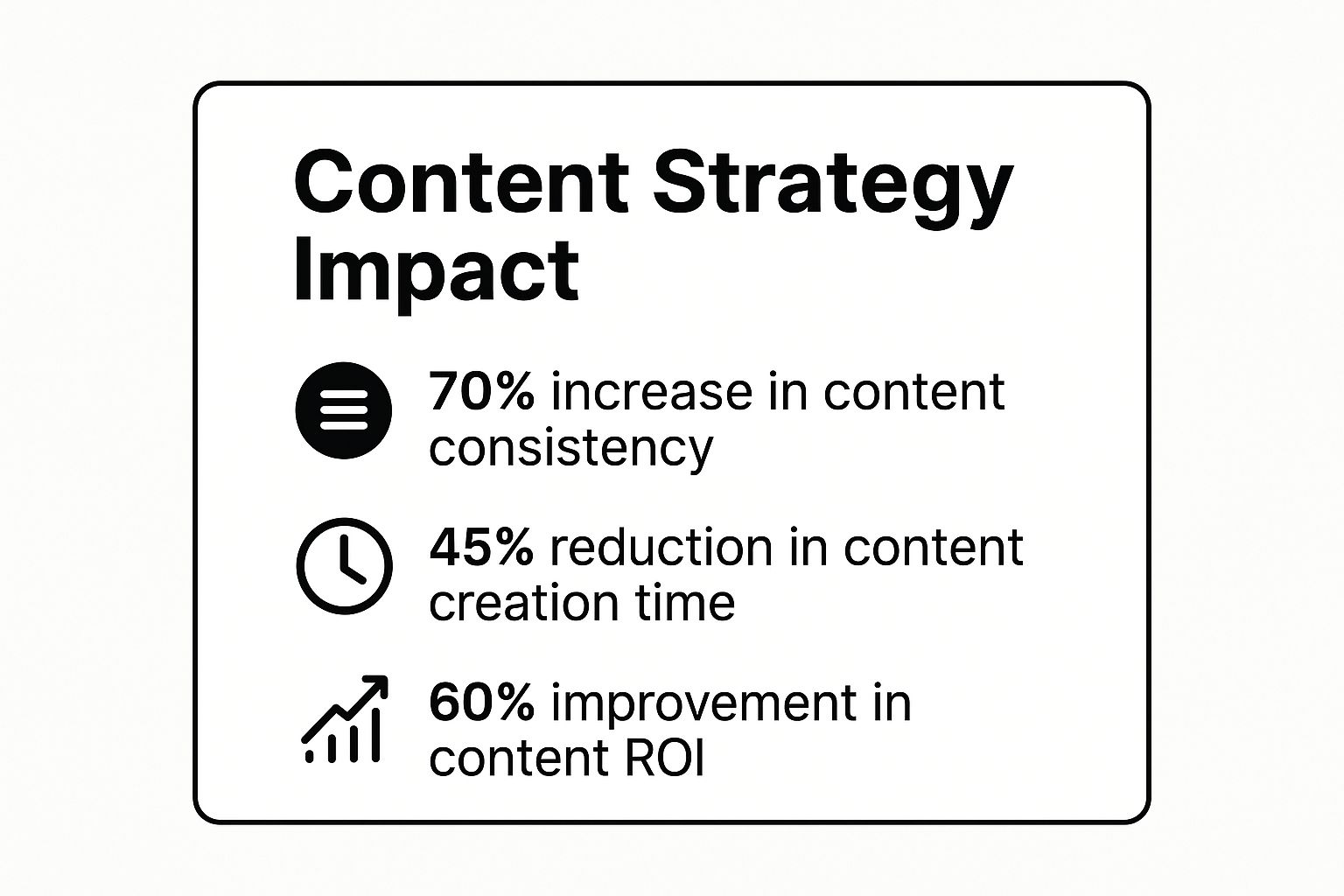
These figures demonstrate how a formalized strategy significantly boosts consistency and ROI while drastically cutting down on production time, proving it's a cornerstone of high-performing content management practices.
2. Version Control and Content History Management
Effective content management requires a systematic approach to tracking and controlling changes. Version control is a critical best practice that ensures every modification to a piece of content is documented, reversible, and coordinated. This prevents conflicting edits, data loss, and maintains the integrity of your content assets throughout their lifecycle, from initial draft to final archive.
Pioneered by figures like Linus Torvalds with the Git system, this practice has expanded beyond software development into modern content operations. Platforms like GitHub for documentation, Confluence for collaborative wikis, and even Google Docs with its revision history all apply these principles. By creating an auditable trail of who changed what and when, teams can confidently collaborate on complex documents, revert to previous states if an error is introduced, and manage multiple content variations simultaneously.
Actionable Implementation Steps
To implement robust version control, focus on establishing clear workflows and leveraging tools that automate the process. This practice is essential for teams where multiple contributors work on the same content, ensuring a single source of truth is always maintained. For those interested in advanced setups, exploring a Git-based CMS can offer powerful versioning capabilities.
- Establish Naming Conventions: Create a clear, standardized format for naming versions (e.g.,
v1.0_draft,v1.1_review,v2.0_published) to avoid confusion. - Leverage Branching for Major Edits: For significant content overhauls or campaigns, use a branching strategy to work on new versions in isolation without disrupting the live content.
- Automate Where Possible: Use a Content Management System (CMS) or platform with built-in, automated versioning to reduce manual effort and human error.
- Train Your Team: Ensure all content creators and editors understand the version control workflow, including how to commit changes, write descriptive comments, and revert to previous versions.
Adopting a disciplined approach to version control is a cornerstone of mature content management best practices, safeguarding your content's quality and consistency.
3. Content Taxonomy and Information Architecture
Effective content management is impossible without a logical framework for organization. This is where a robust content taxonomy and a clear information architecture become indispensable. This practice involves systematically organizing and categorizing your content using hierarchical structures, metadata, and tagging systems. The primary goal is to make information easily discoverable for users and manageable for your team, creating intuitive pathways that guide users to relevant information efficiently.
Information architecture pioneers like Peter Morville and Louis Rosenfeld established that a well-designed structure is the backbone of any successful digital experience. A strong taxonomy acts as the internal skeleton for your content, defining relationships between different pieces and ensuring scalability. Examples like Amazon's product categorization or The New York Times' topic-based organization demonstrate how this structured approach enhances user navigation and engagement. Without it, even the highest quality content can get lost in a disorganized repository, rendering it useless.

Actionable Implementation Steps
To implement a functional taxonomy, you must begin by understanding how your audience thinks and searches for information. This user-centric approach ensures your organizational structure aligns with user expectations, making your content more intuitive to navigate.
- Start with User Research: Conduct card sorting exercises or user interviews to understand your audience's mental models and how they naturally group information.
- Establish a Controlled Vocabulary: Create a standardized list of terms and tags to ensure consistency across all content. Implement strict tag governance to prevent the system from becoming diluted or confusing.
- Balance Depth and Breadth: Design a category structure that is deep enough to be specific but not so complex that it overwhelms users. A well-balanced hierarchy is key to discoverability.
By implementing a deliberate information architecture, you directly improve the user experience and support backend content management efficiency. A logical structure is fundamental for systems like a knowledge base CMS, where quick access to information is critical. You can learn more about how taxonomy supports knowledge management systems and see these principles in action. This structured approach is a cornerstone of advanced content management best practices.
4. Quality Assurance and Content Review Workflows
Publishing content without a systematic review process is a significant business risk. A core component of content management best practices is establishing robust quality assurance (QA) and review workflows. This involves creating a structured, multi-stage process for editing, fact-checking, and approving all content before it goes live, ensuring it meets brand standards for accuracy, tone, and quality.
This disciplined approach transforms content creation from an isolated task into a collaborative effort focused on excellence. Organizations like the Associated Press have long championed this through style guides, while modern tools like Grammarly bring automated checks into the workflow. The goal is to build a predictable system where content passes through designated checkpoints, such as peer review, editorial sign-off, and legal or compliance checks, guaranteeing consistency and mitigating errors before they reach the audience.
Actionable Implementation Steps
To implement an effective QA process, focus on clarity, accountability, and standardization. The system should be rigorous enough to catch errors but streamlined enough to prevent bottlenecks in your content pipeline.
- Define Clear Review Stages: Establish distinct roles and responsibilities for each phase, such as writer, editor, subject matter expert, and final approver. Document what each person is accountable for checking.
- Use Standardized Checklists: Create templates and quality assurance checklists for reviewers to follow. This ensures every piece of content is evaluated against the same criteria for style, grammar, brand voice, and SEO.
- Set Realistic Timelines: Build review cycles directly into your production schedules. Allocate sufficient time for each stage to allow for thorough feedback and revisions without rushing the process.
By formalizing the review process, you safeguard your brand's reputation and ensure every piece of content is an accurate, polished reflection of your organization. This structured oversight is crucial for maintaining high standards at scale and is a non-negotiable part of modern content operations.
5. Content Lifecycle Management
Effective content doesn't just appear; it evolves. Content lifecycle management is the strategic process of guiding a piece of content from its initial creation through its eventual retirement. This framework ensures that your content library remains accurate, relevant, and valuable by systematically auditing, updating, archiving, or deleting assets, which is a core tenet of modern content management best practices.
Pioneered by organizations like the Nielsen Norman Group, this approach views content as a dynamic asset with a finite lifespan, not a static "set-it-and-forget-it" publication. It involves establishing clear governance for each stage of content's existence. For example, Mayo Clinic employs a rigorous lifecycle for its medical articles with scheduled reviews to maintain accuracy, while Microsoft manages its vast technical documentation library through structured updates and archival, ensuring users always have access to current information. This structured oversight prevents content decay, improves user experience, and optimizes resources.
Actionable Implementation Steps
To implement this, you must shift from a purely production-focused mindset to a holistic management perspective. This involves creating a system that tracks and acts upon content based on its age, performance, and strategic relevance.
- Establish Clear Lifecycle Policies: Define triggers for content review (e.g., 12 months post-publication, a significant drop in traffic) and create standardized workflows for updating, archiving, or deleting content.
- Use Metadata for Tracking: Implement metadata tags to track key dates (published, last updated, next review), ownership, and performance metrics, making it easier to automate and manage the process at scale.
- Automate Review Alerts: Use your CMS or project management tools to set up automated notifications that alert content owners when an asset is due for its scheduled review, ensuring nothing falls through the cracks.
6. Multi-channel Content Distribution and Syndication
Creating excellent content is only half the battle; ensuring it reaches the right audience across multiple touchpoints is equally critical. Multi-channel content distribution involves strategically publishing and promoting a single piece of content across various platforms, such as your blog, social media, email newsletters, and third-party sites. This practice amplifies your message, maximizes reach, and engages users on their preferred channels, turning a single asset into a widespread campaign.
This approach, championed by figures like Gary Vaynerchuk, treats a core content piece as a source for numerous micro-assets tailored to each platform's unique format and audience expectations. For example, a long-form article can be repurposed into a Twitter thread, an Instagram carousel, a LinkedIn post, and a YouTube video. This not only extends the content's lifespan but also reinforces brand messaging consistently across the digital ecosystem, making it a cornerstone of modern content management best practices.
Actionable Implementation Steps
To effectively implement a multi-channel strategy, you must move beyond simply cross-posting. The goal is to adapt content thoughtfully for each platform while maintaining a cohesive brand voice. For comprehensive guidance on expanding your content's reach, delve into the latest content syndication best practices.
- Develop Platform-Specific Guidelines: Create rules for how content should be formatted and presented on each channel, defining image dimensions, character counts, and tone of voice.
- Use a Unified Publishing Tool: Leverage content management systems or tools that support multi-channel publishing to streamline the distribution process from a central dashboard. You can explore a variety of no-code CMS solutions to find one that fits your workflow.
- Monitor Channel-Specific Metrics: Track performance indicators like engagement rates, click-throughs, and conversions separately for each channel to understand what resonates and optimize future distribution efforts.
The strategic distribution of content across multiple channels directly correlates with increased brand visibility, higher engagement rates, and a more robust return on your content investment.

These statistics highlight how a coordinated multi-channel approach not only significantly expands audience reach but also boosts overall engagement and generates more leads, proving its value in a comprehensive content management framework.
7. SEO-Optimized Content Structure and Metadata Management
Effective content management extends beyond creation and storage; it involves a systematic approach to structuring content and managing metadata to maximize search engine visibility. This best practice integrates SEO principles directly into the content lifecycle, ensuring every asset is optimized for discoverability. It focuses on technical and on-page elements like titles, descriptions, headers, and structured data to help search engines understand and rank your content effectively.
This methodology, championed by SEO pioneers like Rand Fishkin, transforms content from a simple communication tool into a high-performing asset that attracts organic traffic. For instance, recipe websites utilize structured data to appear in rich snippets, while e-commerce platforms like Amazon optimize product pages with clear hierarchies and metadata to capture user intent. This structured approach not only improves search rankings but also enhances user experience by making information easy to navigate and digest.
Actionable Implementation Steps
To implement this, integrate SEO checks and optimizations into your content workflow from the very beginning, rather than treating it as an afterthought. This ensures that every piece of published content is primed for search performance and user engagement. For those just starting, choosing the right foundation is key; you can learn more about selecting an SEO-friendly website builder for your business on contenttoolkit.co.
- Structure Content Logically: Use header tags (H1 for the main title, H2s for main sections, H3s for subsections) to create a clear, hierarchical outline that is readable for both users and search crawlers.
- Optimize Critical Metadata: Write unique, compelling title tags and meta descriptions for every page. The description should act as a concise "ad" for your content on the SERP, encouraging clicks.
- Implement Structured Data: Use schema markup for relevant content types like articles, products, events, or FAQs to help search engines generate informative rich snippets, which can significantly improve click-through rates.
8. Content Performance Analytics and Data-Driven Optimization
Creating great content is only half the battle; understanding its impact is what drives sustainable growth. One of the most critical content management best practices involves the systematic analysis of performance data to inform and optimize your strategy. This data-driven approach moves beyond guesswork, allowing you to make decisions based on how your audience actually engages with your content, ensuring that every effort contributes to tangible business outcomes.

This methodology was famously pioneered by digital-native publishers like BuzzFeed, who use analytics to determine everything from headline choices to topic selection. It involves tracking key metrics, conducting A/B tests, and using those insights to continuously refine content for better engagement and conversion. To truly understand the impact of your content and make data-driven decisions, it's essential to master digital marketing performance metrics. By integrating analytics into your workflow, content ceases to be a cost center and becomes a predictable engine for growth.
Actionable Implementation Steps
To implement this practice, shift your focus from pure production to a cycle of creation, measurement, and iteration. This requires integrating analytics tools into your process and fostering a culture where data informs creative decisions.
- Define Clear KPIs: Before publishing, establish specific goals. Are you aiming for traffic, leads, or shares? Define the Key Performance Indicators (KPIs) that align with these objectives.
- Utilize Analytics Tools: Employ platforms like Google Analytics, Semrush, or built-in CMS dashboards to track user behavior, traffic sources, and conversion rates.
- Conduct Regular A/B Tests: Systematically test variables such as headlines, calls-to-action, and content formats to identify what resonates most with your audience.
- Create Performance Dashboards: Consolidate key metrics into a centralized dashboard for easy monitoring. This enables quick identification of trends and performance issues, allowing for agile adjustments.
9. Security, Backup, and Disaster Recovery Planning
Content is a valuable business asset, and protecting it from loss, corruption, or unauthorized access is a critical component of effective content management. This best practice involves implementing a comprehensive strategy for security, regular data backups, and a clear disaster recovery plan. It ensures business continuity and safeguards your content against everything from hardware failures and human error to sophisticated cyberattacks.
This multi-layered approach to content protection has been standardized and popularized by cloud infrastructure leaders like Amazon Web Services (AWS) and security firms like Cloudflare. They advocate for a proactive, not reactive, stance on data integrity. For instance, financial institutions are legally required to maintain stringent content security and compliance measures, while platforms like GitHub use distributed backups and robust disaster recovery protocols to protect immense volumes of user-generated code. This framework transforms security from an afterthought into an integrated part of the content lifecycle.
Actionable Implementation Steps
To effectively protect your content assets, you must build a resilient system that anticipates potential points of failure. This involves creating automated processes and clear protocols that your team can execute reliably.
- Implement Automated Backups: Schedule automated, daily backups of all content assets and databases. Ensure your system maintains multiple restore points and stores copies in at least two geographically diverse, secure locations (e.g., on-premises and in the cloud).
- Establish Robust Security Measures: Enforce strong authentication methods like two-factor authentication (2FA) for all users. Implement granular access controls based on the principle of least privilege, ensuring team members can only access the content relevant to their roles.
- Test Your Recovery Plan Regularly: A disaster recovery plan is useless if it doesn't work. Conduct scheduled tests of your backup restoration procedures at least quarterly to identify and fix any issues before a real emergency occurs, making it a core part of your content management best practices.
9 Key Content Management Practices Comparison
| Item | Implementation Complexity 🔄 | Resource Requirements ⚡ | Expected Outcomes 📊 | Ideal Use Cases 💡 | Key Advantages ⭐ |
|---|---|---|---|---|---|
| Content Strategy Planning and Documentation | High – involves multiple stakeholders and upfront investment | Moderate – requires time and collaboration tools | Improved content consistency, ROI, and efficiency | Long-term content governance and brand alignment | Ensures consistency, data-driven decisions, reduces costs |
| Version Control and Content History Management | Moderate – requires training and setup of versioning systems | Moderate – storage and user training needed | Prevents data loss, enables rollback, improves accountability | Collaborative content editing and compliance | Tracks changes, resolves conflicts, maintains audit trail |
| Content Taxonomy and Information Architecture | High – needs planning and continuous maintenance | Moderate – requires expertise and governance | Better content discoverability, navigation, and SEO | Large content libraries with diverse info | Enhances UX, scalability, automated recommendations |
| Quality Assurance and Content Review Workflows | Moderate to High – involves coordination of multiple reviewers | High – needs resources for reviews and approvals | Reduces errors, enforces brand standards, increases credibility | High-stakes or brand-critical content production | Minimizes errors, ensures compliance, improves quality |
| Content Lifecycle Management | Moderate to High – requires policy setup and ongoing maintenance | Moderate – needs tools for audits and automated alerts | Keeps content fresh, reduces storage costs, ensures compliance | Continuous content upkeep and archival | Maintains relevance, reduces bloat, supports compliance |
| Multi-channel Content Distribution and Syndication | High – involves complex coordination and cross-platform optimization | High – needs platform-specific skills and systems | Maximized reach and engagement across channels | Omnichannel marketing and content repurposing | Expands audience, increases ROI, supports segmentation |
| SEO-Optimized Content Structure and Metadata Management | Moderate – requires SEO expertise and ongoing updates | Moderate – technical and content resources needed | Improved organic search ranking and user experience | Content focused on search visibility and traffic growth | Boosts discoverability, supports rich results, enhances UX |
| Content Performance Analytics and Data-Driven Optimization | High – requires analytics tools and data expertise | High – investment in analytics platforms and training | Data-driven decisions, improved ROI and user engagement | Optimization of content effectiveness | Enables continuous improvement, identifies patterns, ROI focus |
| Security, Backup, and Disaster Recovery Planning | High – complex infrastructure and security expertise required | High – infrastructure and ongoing monitoring | Protects content integrity and availability, ensures compliance | Content with regulatory or business continuity needs | Prevents data loss, ensures resilience, reduces risk |
Implementing Your Content Management Blueprint
The journey through these nine content management best practices reveals a fundamental truth: effective content management is not a series of isolated actions but an integrated, strategic system. It’s the architectural blueprint that supports every piece of content you create, from its initial concept to its eventual archival. Moving beyond disjointed tasks to a cohesive framework is what separates fleeting content success from sustained, scalable impact.
We’ve covered the critical pillars, from establishing a documented Content Strategy and maintaining rigorous Version Control, to building a logical Content Taxonomy that makes information accessible. We explored the non-negotiable need for structured Quality Assurance Workflows and proactive Content Lifecycle Management. Furthermore, we detailed how to amplify reach through Multi-channel Distribution, enhance visibility with SEO-Optimized Structures, and refine your approach using Performance Analytics. Finally, we underscored the importance of a robust Security and Backup Plan to protect your valuable assets.
From Blueprint to Reality: Your Actionable Next Steps
Mastering this discipline requires moving from understanding to implementation. The sheer volume of best practices can feel overwhelming, but progress is made through methodical, incremental change. Here is a practical roadmap to get started:
Conduct a Gap Analysis: Begin by auditing your current content operations against the nine pillars discussed. Use a simple scoring system (e.g., 1-5) to rate your organization's maturity in each area. This objective assessment will immediately highlight your most significant vulnerabilities and opportunities for improvement. Are you excelling in SEO but failing at version control? Is your quality assurance process solid but your content lifecycle non-existent? Identify the one or two areas where focused effort will yield the greatest return.
Prioritize and Pilot: Don't attempt to overhaul everything simultaneously. Select the highest-priority area from your gap analysis and launch a pilot project. For instance, if your taxonomy is a critical weakness, start by re-organizing a single section of your blog or resource center. Document the process, train a small team, and measure the results. This focused approach allows you to refine your methodology before a full-scale rollout.
Empower with the Right Toolkit: Technology is the enabler of these best practices. A spreadsheet can't manage a complex content lifecycle, and shared documents are no substitute for a real version control system. Re-evaluate your current content management system (CMS) and supporting tools. Do they facilitate structured workflows, detailed analytics, and secure backups? If not, it's time to explore alternatives that align with your strategic goals.
The Lasting Impact of a Managed Ecosystem
Adopting these content management best practices is more than an operational upgrade; it's a strategic investment in your brand's authority, efficiency, and long-term value. A well-managed content ecosystem reduces wasted resources, mitigates security risks, and ensures every asset you produce works harder to achieve your business objectives. By transforming your content from a collection of files into a structured, optimized, and secure library of assets, you build a foundation for consistent excellence and sustainable growth. The blueprint is now in your hands; the next step is to start building.